


Although Spanish colonists introduced wine growing in Argentina in 1551, the export of Argentine wine only really started to develop in the 1990s. Thanks to reforms, quality wine could be produced in addition to bulk wine with the help of foreign investment. Argentine Malbec became a global brand. Argentina has conquered its place on the international wine map. In recent years, we have also seen an increase in organic and biodynamic wine growing. Some Argentine winemakers even make natural wines.
The arrival of Spanish colonists marked the beginning of wine growing in Argentina. Priestly vineyards, planted at missions such as the Franciscans and Jesuits, produced grapes such as Criolla Grande for making wines for communion. The Jesuit mission in Jesus Maria, Cordoba, was already reporting the production of white wine in 1618.
The true revolution in Argentine wine growing began when the Argentine president asked French agronomist Michel Pouget to bring Malbec, Cabernet Sauvignon and Cabernet Franc vines to Mendoza on 17 April 1853. Since then, Malbec World Day has been celebrated every year on 17 April. It marked the start of a new era for Argentine wine.
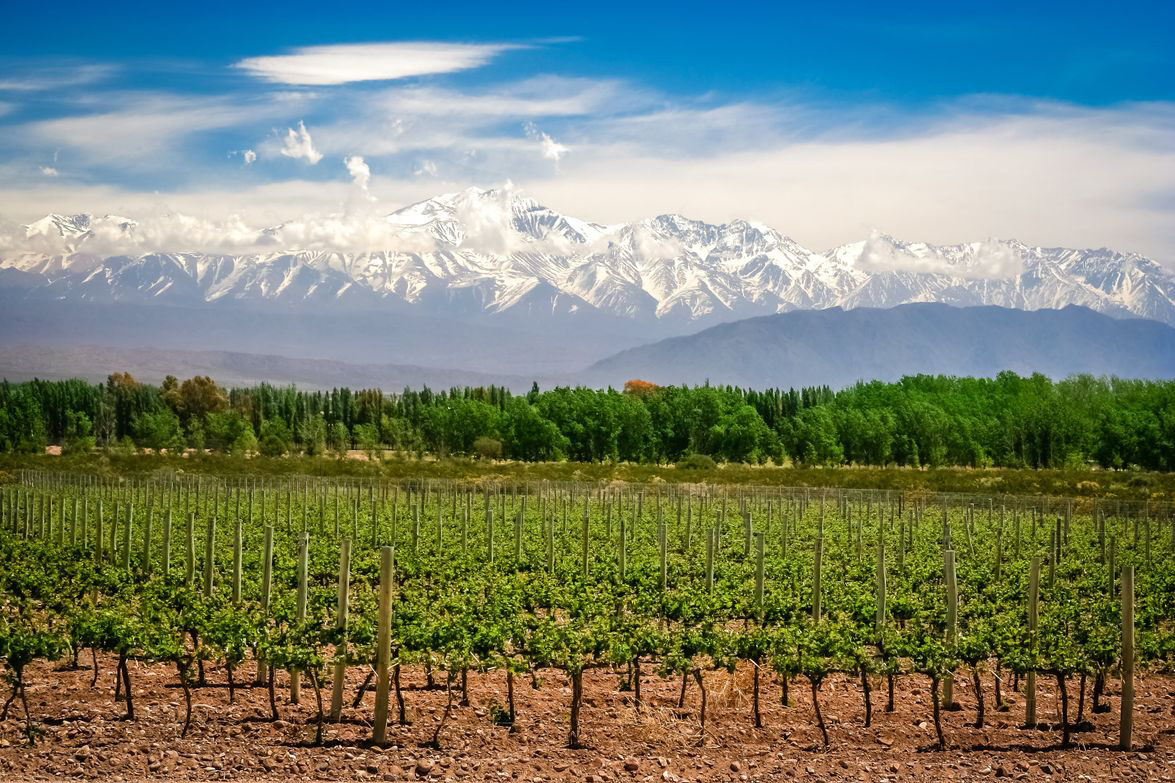
Since the 1990s, more and more new vineyards have been planted at ever higher altitudes. Where in Europe wine is grown with difficulty at this altitude, in Argentina it is a blessing. The wines mainly flourish between 700 and 1400 meters altitude. One of the most planted grapes is the Malbec, which has adapted perfectly to the environment and has slightly smaller and denser bunches than the Malbec from the South of France.
The climate of Mendoza is considered a warm climate for wine, but the high altitude with its cool nights and winters create an ideal environment. The freshness and flavor intensity develop perfectly. Not only the Malbec flourishes here. Wines made from Cabernet Sauvignon, Syrah, Tempranillo, Sangiovese and Merlot also all produce wines with powerful and ripe flavors.
The Argentine province of La Rioja is the oldest wine region in Argentina and is known for its own typical style of planting the Torrontés Riojana in pergola form. San Juan is the only province that still comes close to Mendoza in terms of hectoliters. Popular grapes in this region are Muscat d’Alexandrie and Syrah.
Because we are on the other side of the equator, this means that the southernmost wine region, Patagonia, is also the coolest. Here, in addition to the grapes already discussed, we also find many white grapes such as Chardonnay, Sauvignon Blanc, Viognier and Gewürztraminer, among others.
The Patagonians thank the strong, relentless wind for the quality of their vines. They swear that - while you can hear the melodious whisper of the wind through the vines and the vines sway with the gusts of wind - the roots are more firmly anchored in the ground and can develop more concentrated flavors. We have not yet been able to check the latter ourselves...




 Orange wine (31)
 Fresh (95)
 Light (35)
 Rosé (17)
 Aromatic (21)
 Medium (99)
 Sparkling (32)
 Ripe (72)
 Full-bodied (95)