

Biodynamic winegrowers go a step further than organic winegrowers. They see their business as a 'living organism'. All aspects of the farm and nature are connected. The farm is self-sufficient. This means, for example, that the vineyard itself is also seen as a living organism. It must be kept healthy with the compost it produces itself. The position of the celestial bodies plays an important role in this.
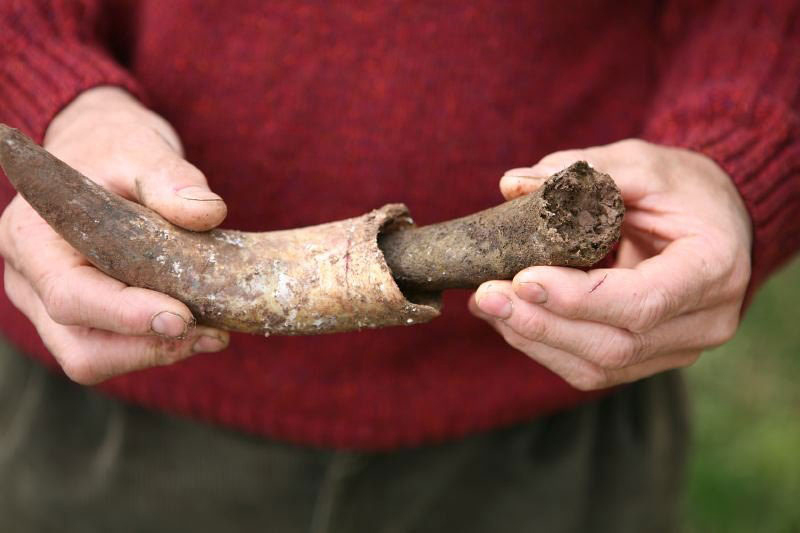
One of the most remarkable methods of biodynamic winegrowers is the use of preparations to enrich compost. Specific plant remains, minerals and cow manure are buried in cow horns. Some time later they are processed into compost or spread in the vineyards. This method contributes to the esoteric image. On the other hand, scientists concluded that the 'biodynamic compost' became warmer and decomposed faster. The biodynamically processed soil contains more micro-organisms and the roots of the vines are thicker.
The position of the celestial bodies is crucial for biodynamic winegrowers. A waning moon is a good time to prune or plough. Sowing and planting is typically suitable when the moon is opposite Saturn. The bottom line is that the cosmos has a rhythm that directly influences nature on earth and biodynamic winegrowers explicitly take this into account in everything they do.
Biodynamic viticulture is based on the non-scientific philosophy of Rudolf Steiner (1861 - 1925). In the first half of the last century, Central European winegrowers were concerned that the industrialization of agriculture was affecting the quality of their soil and products. They invited the Austrian philosopher Rudolf Steiner to give a series of lectures. With his lectures, Steiner became the founder of Biodynamic viticulture, although the methods have been adapted over the years.
At a blind tasting organized by the American magazine Fortune, seven of the country's greatest wine experts were invited to taste ten pairs of wines. One bottle of each pair was biodynamic. To their own surprise, the experts chose the biodynamic wine as the best nine times.
Moreover, it is not exactly the first and best winegrowers who have 'converted' to Biodynamic viticulture in recent years. But that is precisely what fuels the critics who claim that the same results would be achieved without obscure compost preparations or taking into account the position of the stars.
The fact is that the success of Biodynamic viticulture cannot be explained scientifically. As long as that remains the case, Biodynamic viticulture will be viewed with suspicion. That the vagueness in practice is not so bad can be read in this interview with Monty Waldin, an expert in the field of Biodynamic viticulture.




 Orange wine (31)
 Fresh (95)
 Light (35)
 Rosé (17)
 Aromatic (21)
 Medium (99)
 Sparkling (32)
 Ripe (72)
 Full-bodied (95)