


Israel lies in the Middle East on the Mediterranean Sea. Although the climate is Mediterranean in nature, there are clear differences between the microclimates. Vines near the coast have to cope with warm, humid summers, while the vineyards further north benefit from cooler conditions. Further south, in the Negev Desert, it is even drier and irrigation is essential. The 6,000 hectares of vineyards are spread across four wine regions.
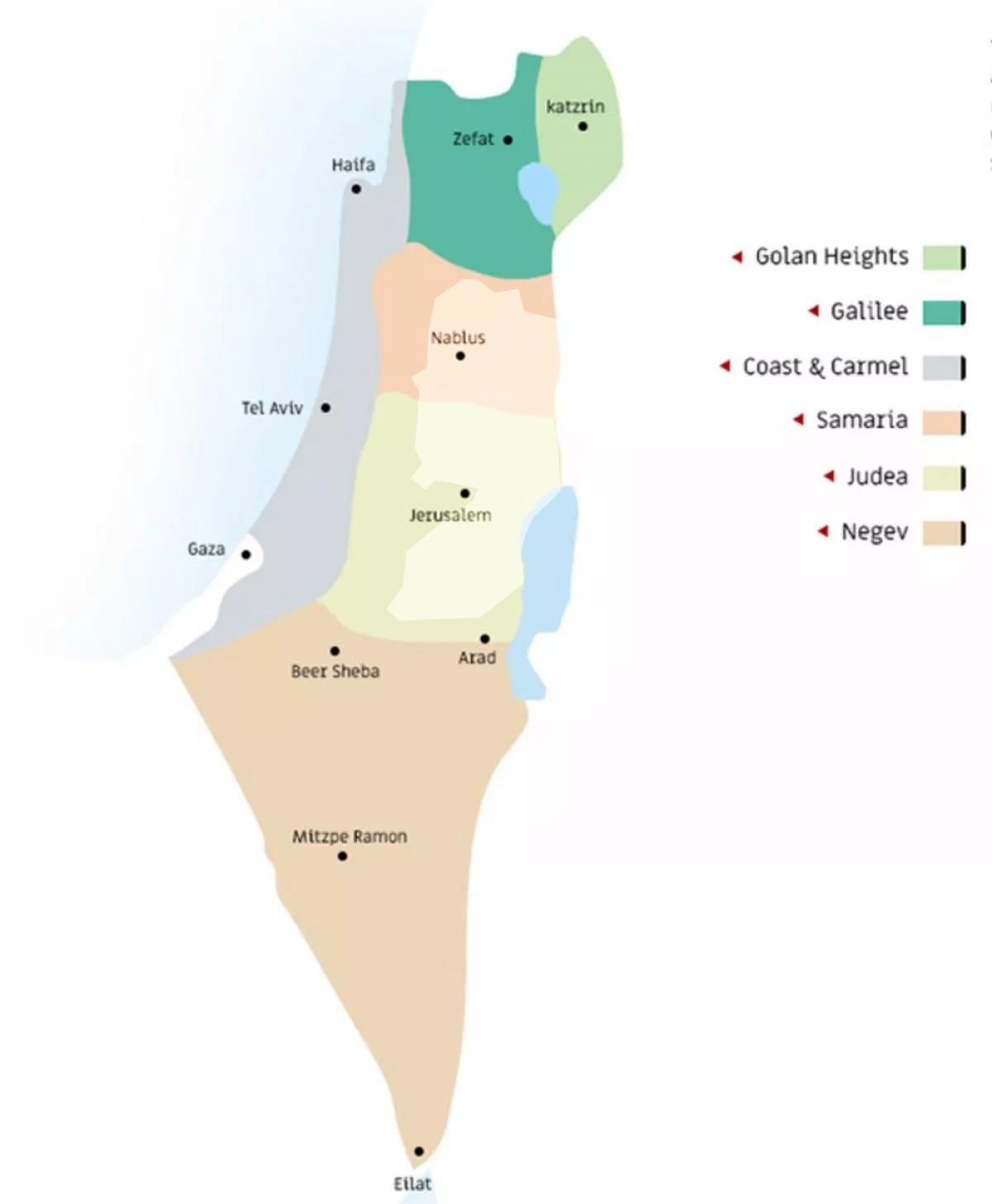
The map above shows the wine regions of the area. It is not a political map. Parts of the Judea and Samaria wine regions lie in the West Bank and are therefore not part of Israel.
Galilee, the northernmost wine region, has an excellent reputation. The region has the best conditions for producing quality wines, especially since the late twentieth century, when Californian expertise helped match grape varieties to the most suitable terroir. The high-lying Golan Heights are one of Galilee's best-known subregions: relatively cool and dry, with large differences between day and night temperatures. The heat of the day is stored, and as it cools down at night, the aromas can develop slowly. Wines from Galilee are therefore characterised by intense fruit combined with juicy acidity. The soil consists of volcanic rock, slate and chalk. Grape varieties such as Sauvignon Blanc, Cabernet Sauvignon and Merlot thrive here, and the cool conditions suit Riesling too.
Samaria's climate is characterised by rainy winters and warm, humid summers. French grape varieties and even Zinfandel are planted here, and both still and sparkling wines are made. The region is home to the Zikhron Ya'akov winery, built in 1892 with investment from Baron Rothschild. Today it is part of Carmel, Israel's largest winery. Part of the Samaria region lies in the West Bank and is not part of Israel.
Harey Yehuda, the Judean Hills, border Jerusalem. The vineyards are scattered across the region, on hills that protect the vines from too much sun and heat. The cool nights allow the grapes to ripen slowly. Dry wines are made here from Chardonnay, Merlot, Grenache and Cabernet Sauvignon, often aged in French oak. Part of Judea's vineyards lies in the occupied West Bank and is therefore not part of Israel.
Hanegev's vineyards lie in the Negev Desert. To make winegrowing possible, the vines have been planted at altitude on relatively cool hills and trained so that the grapes hang in the shade. Irrigation is essential given the heat and drought.



 Orange wine (31)
 Fresh (95)
 Light (36)
 Rosé (17)
 Aromatic (21)
 Medium (99)
 Sparkling (32)
 Ripe (72)
 Full-bodied (96)