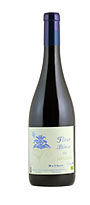
You won't often come across a red Grolleau in your glass. If you do, it will be pale in colour, light-bodied and supple, with little tannin and fresh acidity. On the nose you mainly find red fruit such as strawberries, raspberries and cherries, sometimes with a hint of black pepper, herbs or flowers. As a red it is a real thirst-quencher, best drunk young and lightly chilled. As a rosé, Grolleau is far more common: it is the backbone of the well-known Rosé d'Anjou.
Grolleau comes from the Loire, from Touraine to be precise. According to an old source, a farmer named Lothion planted it around 1810 near Cinq-Mars-la-Pile, west of Tours. After a few years that single vine had grown so large that it covered an entire pear tree. The neighbours took cuttings, and the grape quickly spread, including to the other bank of the Loire. That is why it is also known as Grolleau de Cinq-Mars.
The name Grolleau probably comes from the old French word grolle, meaning crow, after the jet-black colour of the berries. Another synonym is Gros-Lot, literally 'the jackpot'. The story goes that the name came from the fortune growers made from it, but that is a myth. DNA analysis has shown that Grolleau, like Chardonnay and Gamay, is one of the many offspring of the old and almost extinct white grape Gouais Blanc.
Grolleau gives high yields per hectare. For a long time that was both its strength and its weakness: leave the vine to its own devices and you get a lot of wine, but thin wine. For good wine, the grower has to make generous use of the pruning shears. Its vineyard area has shrunk considerably, from more than 11,000 hectares in 1958 to around 2,350 hectares in 2009. Even so, Grolleau is still the Loire's third red grape after Cabernet Franc and Gamay. Thanks to its high yields it still accounts for roughly one sixth of all Loire wine. It is found mainly west of Tours and in Anjou.
By far the largest part of Grolleau ends up as rosé. Rosé d'Anjou, the well-known soft, slightly sweet pink wine, is made mostly from Grolleau, often blended with Gamay. In Touraine it is used for drier rosés. The grape is also permitted in the dry Rosé de Loire and in the sparkling Saumur Brut. There are also a pink and a white version of the grape, Grolleau Gris and Grolleau Blanc. Grolleau Gris has actually become more popular in recent decades and is used mainly for rosé and sparkling wine.
For a long time Grolleau had a reputation as a bulk grape for cheap sweet rosé, and many critics looked down on it. In recent years it has been given a second life. Especially in Anjou, now one of the centres of the natural wine movement in France, winemakers are discovering that Grolleau from old vines, with low yields, makes delicious light red wines: pale, juicy, fruity and sometimes a little peppery. Many of these wines are sold as Vin de France, outside the appellation rules. Red Grolleau is best drunk lightly chilled, with charcuterie, a salad or a picnic, or simply on its own on the terrace.
We currently have one wine made from the Grolleau grape in our range. You can view our Grolleau wine here.



 Orange wine (27)
 Fresh (94)
 Light (39)
 Rosé (10)
 Aromatic (22)
 Medium (98)
 Sparkling (23)
 Ripe (71)
 Full-bodied (99)