


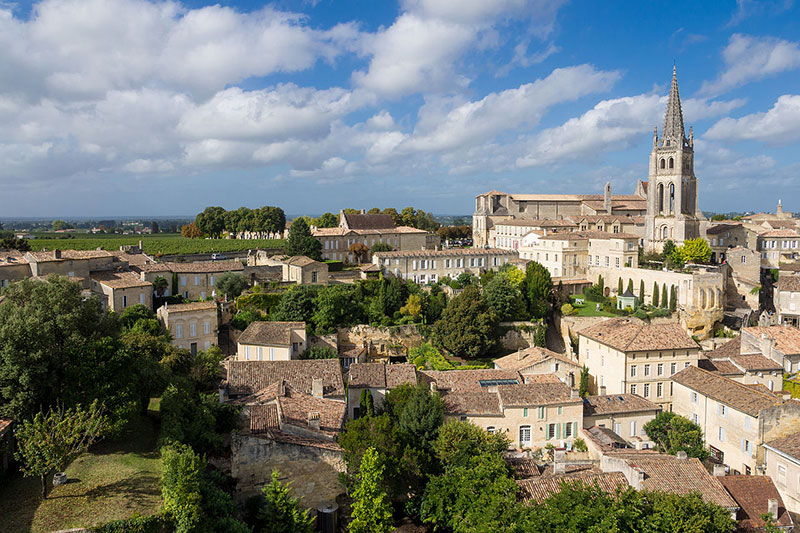
For many wine lovers, the beautiful town of Saint-Emilion is a place of pilgrimage. On and around the hill of Saint-Emilion lie the vineyards. They differ greatly from each other. Especially in terms of soil composition and position in relation to the sun. But in all vineyards, the Merlot is the most important inhabitant.
In Saint-Emilion, Merlot is blended with Cabernet Sauvignon and Cabernet Franc. A good Saint-Emilion can be stored for a long time, which is certainly not the case for all Merlot wines. But Saint-Emilion is a region where Merlot shows its best side.
More than half of the wine from Saint-Emilion is Grand Cru. This title therefore does not say much. And when you see a Saint-Emilion Grand Cru for ten euros at the liquor store or on the internet, there is a good chance that - despite the beautiful label - you are dealing with a simple wine.
The best wines from Saint-Emilion are the Premier Cru Classées A and B. Only the Châteaux Ausone and Cheval-Blanc have a Premier Cru Classée A classification. Eleven wineries are allowed to put Classée B on their labels.
The terroirs of the approximately 50 square kilometres of vineyards of Saint-Emilion vary greatly. The best vineyards are located on the so-called Plateau, on top of the hill of Saint-Emilion. A layer of clay lies on limestone here, with a lot of gravel in the soil. The slopes of the Plateau - the côtes - are located on less good soil, but favourable in relation to the sun. The flatter part consists mainly of gravel and pumice.
The municipalities of Montagne, Lussac, Saint-Georges and Puisseguin are located around Saint-Emilion. They are allowed to add their name of origin to the region name Saint-Emilion. Here too, Merlot dominates. The vineyards are less favourable for winemaking than those of Saint-Emilion itself. But the price is generally also a lot lower.



 Orange wine (27)
 Fresh (90)
 Light (36)
 Rosé (14)
 Aromatic (22)
 Medium (98)
 Sparkling (27)
 Ripe (71)
 Full-bodied (99)