When you think of South African wines, you immediately think of Stellenbosch. This is where South African wine growing began in the seventeenth century. Stellenbosch is very varied in terms of landscape, soil and climate. This also applies to the wines that come from there. Stellenbosch is divided into several small 'wards' (micro-climate zones) with very regional wines. Some of the best wines of South Africa (still) come from Stellenbosch.
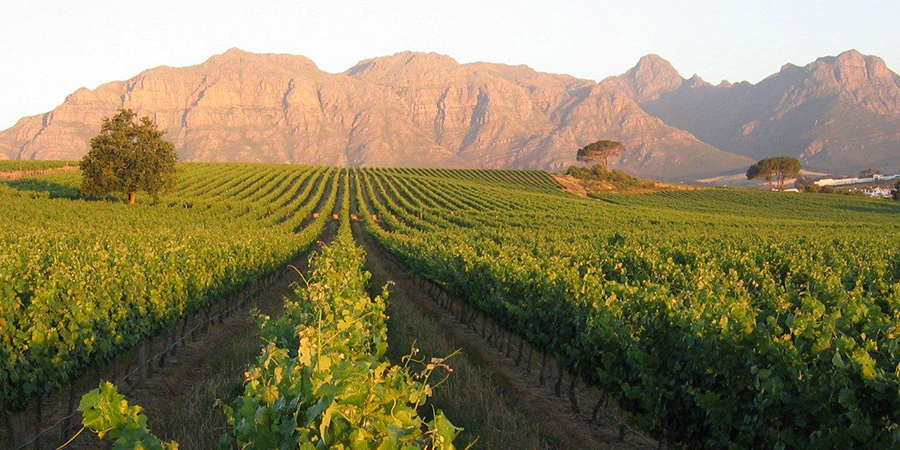
Stellenbosch is perhaps the most famous wine district in South Africa. Traditionally. The Cape of Good Hope was a strategic point on the route of the VOC ships in the 17th century. Ships moored, the crews provided business and trade. They soon discovered the area east of Cape Town. A small settlement was designated Stellenbosch in 1679, named after the governor of the Cape. This region turned out to be very suitable for wine growing.
The first vine was planted in Stellenbosch in 1652 by Jan van Riebeeck. And yes, in 1659 the first wines from Cape soil were drunk. The ships could be supplied with the fruits of this land, the crew refreshed themselves with the fresh food on shore and of course this had to be washed down with wine. The commercial hearts in Stellenbosch started beating faster. There was a thirst for wine that had to be quenched.
Simon van der Stel, as governor of the city of Stellenbosch, also did his part. He planted vines in the Wildebosch Valley – later also named after Stellenbosch itself. Simon even wrote manuals on viticulture. The arrival of the French Huguenots in 1685 brought even more vines and the necessary knowledge development, which only improved the quality of the wines.
Over time, the Stellenbosch vineyards expanded into the surrounding valleys with sandy soils. And into the hills of Hottentots-Holland, Jonkerberg and Simonsberg with heavier granite soils. The Stellenbosch district seemed to be one vineyard; a patchwork of different terroirs and grape varieties.
Due to differences in altitude in the landscape, influences from the ocean and the soil composition, every vineyard in Stellenbosch seems to score differently on the map of terroir. It is therefore not surprising that the Stellenbosch district is divided into smaller wards: Simonsberg-Stellenbosch, Jonkershoek Vallei, Papegaaiberg, Bottelary, Banghoek, Devon Valley and Polkadraai. Each ward has its own characteristic terroir and specialty.
The Stellenbosch district is known for its blends and wines made mainly from blue grape varieties. More than two-thirds of the area is planted with Cabernet Sauvignon, Pinotage, Shiraz and Merlot, among others. These grape varieties do well on soils of weathered granite types and clay. Soils that are good at retaining moisture. The white wines are made mainly from Sauvignon Blanc, Chenin Blanc and Chardonnay.
Not only in the 17th century but also today Stellenbosch is an interesting destination for wine lovers. Wine tourism seems to have been invented here. The extensive wine route along picturesque wineries, many of which are still in colonial style, dates from 1971. In the meantime, the counter stands at more than 150 wineries that you can visit. And if you want to go even further than just wine tasting, you can obtain a degree in viticulture and oenology. The University of Stellenbosch, founded in 1918, is still a renowned place for 'wine students' from all over the world. We currently have four wines from Stellenbosch in our range. You can view all our wines from Stellenbosch here.



 Orange wine (27)
 Fresh (90)
 Light (36)
 Rosé (14)
 Aromatic (22)
 Medium (98)
 Sparkling (27)
 Ripe (71)
 Full-bodied (99)