


Swartland is now one of the most exciting wine regions in South Africa. In the past, wine was mainly produced in bulk. But in the last twenty years, dozens of talented, adventurous winemakers have settled here, searching the district for specific terroirs. They make modern, quality wines and are not afraid to experiment. Swartland owes its name to the black soils that contain a lot of granite and the bushes that turn black after rainfall.
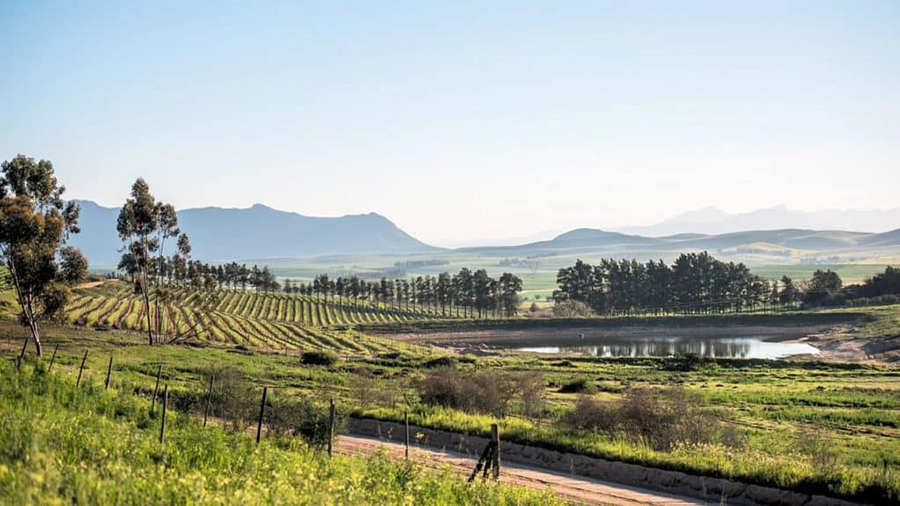
Swartland, or the ‘black land’, owes its name to the many shrubs of the indigenous ‘renosterbos’ that this area in the north of the Western Cape was rich in. After rainfall in the winter, they turned as black as rhinoceroses. In addition, the dark soil contains a lot of granite. Swartland could also have been called the ‘Bread Basket of South Africa’ or the ‘Gold Coast’ in the 17th century, after the golden-coloured grain that was grown everywhere.
It was not until the middle of the 18th century that the first vines were planted in Swartland. The warm and dry Mediterranean weather also proved to be extremely suitable for viticulture. In addition, breezes from the Atlantic Ocean provide a welcome cooling. The vines rooted in soils of granite, shale, sandstone and schist thrive there. The vineyards are located along the banks of the Berg River and on the rolling hills of mountains such as Riebeek, Piketberg, Porterville and in the south Paardeberg.
Just like the terroir, the diversity in grape varieties is great. In addition to Chenin Blanc, Rhône varieties, Sauvignon Blanc, Clairette Blanche, Muscat and also Groendruif (Sémillon) and Vaalblaar (Palomino) are planted. At the top of the list of blue grapes is Shiraz, followed by Mourvèdre, Cabernet Sauvignon, Pinotage and Grenache.
Vine growing in Swartland used to flourish mainly in quantity: cheap basic wines, robust red, fortified and sweet wines. As a result, Swartland used to be not very interesting for the wine lover and the 'small' winemaker. That has changed a lot in the meantime.
Until 1995, the year that cheese and winemaker Charles Back from Paarl accidentally came across a special Swartland wine from Sauvignon Blanc. He immediately decided to buy the vineyards and chose Eben Sadie, now an icon of Swartland wines, to make wine from them. This was the beginning of the 'Swartland Revolution'. Charles and Eben took the diversity in the terroir as a starting point for the grapes they grew. Their enthusiasm and the quality of their wines were infectious. More and more adventurous winemakers moved to Swartland to make wine and take over vineyards. Sometimes with very old bush vines of Chenin Blanc.
United by the desire to make wines that reflect the terroir, these winemakers united in the 'Swartland Independent Producers' (SIP). A close-knit community that encourages each other to make wines that are as natural as possible. Everything for the authenticity of the wines. Such as the use of no more than 25% French oak, no added yeasts or acids. In addition, dry viticulture is used, or no irrigation. There is also a restriction on the types of grape varieties that may be used. Every year in November, they celebrate their wines during the Swartland Revolution Festival.
The Swartland Revolution has caused quite a stir in Swartland. Winemakers such as Mullineux, Badenhorst and Sadie have Swartland wines on the menu. Because they all do things a little differently. Swartland is the land of the wine cowboys



 Orange wine (27)
 Fresh (90)
 Light (36)
 Rosé (14)
 Aromatic (22)
 Medium (98)
 Sparkling (27)
 Ripe (71)
 Full-bodied (99)