In western Canada, on the border with North America, lies the Okanagan Valley. A valley more than 400 kilometres inland from Vancouver. In this valley there are a number of lakes from north to south, with Okanagan Lake as the largest lake. The valley is on a similar latitude as Champagne, just suitable for wine growing. But what Okanagan does have in contrast to Champagne is dryness, many hours of sunshine and warmth. And so exceptionally beautiful wines are made here.
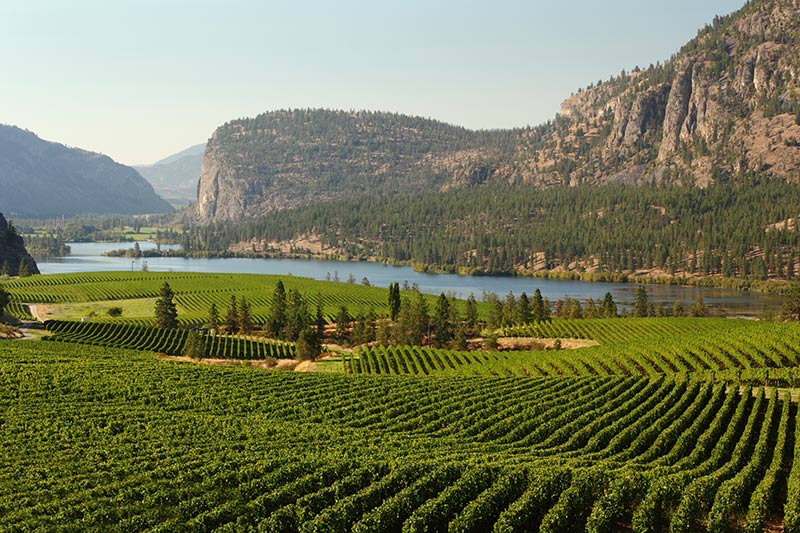
The Okanagan lakes are essential for wine growing. They temper the extreme heat in summer and the extreme cold in winter. And the reflection of the sun in the water contributes to the ripeness of the grapes. The Okanagan Valley is characterized by its short ripening period. Winter starts in mid-October. So the grapes must be sufficiently ripe and harvested before then. Fortunately, Okanagan Valley even has more hours of sunshine than California!
It can get very cold at night. The grapes like that. And we like it. The wines retain their juicy acids in this way. This valley was once a glacier. If you dive into the soil around the lakes, you will still find deposits from this time, of limestone, sandstone and loam, but also of granite and volcanic rocks. This soil only benefits the ripe aromas in the grapes and therefore in the wine.
It is somewhat cooler in the north of the Okanagan Valley. There is an average of 400 mm of rain. Early-ripening and white grape varieties do particularly well here. Around Kelowna, the soil is light and contains a lot of limestone. Wines from Pinot Noir and Chardonnay are therefore elegant, fruity and retain their fresh acidity. The same applies to Riesling, Pinot Gris and Gewürztraminer.
Further south, near the border with the United States, the climate in the valley is hot and dry. This is where the Sonoran Desert begins. There is only 152 mm of rain per year. Without irrigation, viticulture would not be feasible here. Most of the vineyards in the Okanagan Valley are located around Oliver and Lake Osoyoos. And a different terroir also means different grape varieties and a different style of wine. Syrah, for example. The wines from the south of the Valley are comparable to wines from the Northern Rhône, with more elegance and less ‘in your face’ tannins.
In addition to Syrah, Grenache and Mourvèdre, and Cabernet Franc and Merlot are planted on the vineyards on the eastern slopes facing east. These vineyards have granite and sand in the soil. The Chardonnay wines are riper here than in the north of the valley. They have more tropical fruit and a fuller body. This ripeness also applies to the Rieslings. Almost comparable to Rieslings from Alsace or the Rheingau.
The winemakers from the Okanagan Valley like to be inspired by other wine countries to take their wines to an ever higher level. Many winemakers come from countries such as New Zealand, France and South Africa. The area offers enormous opportunities for biodynamic and organic viticulture. The drought, especially in the south, the cold and the lack of phylloxera and other pests make this possible. We currently have ten wines from Okanagan Valley in our range. You can view all our wines from Okanagan Valley here.



 Orange wine (27)
 Fresh (90)
 Light (36)
 Rosé (14)
 Aromatic (22)
 Medium (98)
 Sparkling (27)
 Ripe (71)
 Full-bodied (99)