


When people think of Georgian wine, they soon think of the qvevri: the large, egg-shaped clay vessel in which Georgians have been making wine for thousands of years. Qvevris are buried in the ground in the wine cellar. The grapes go in with their skins and pips, sometimes even with the stems. The juice ferments in the qvevri and then stays there to mature for a few weeks, sometimes up to a year. After long skin contact in the qvevri, wine from white grapes turns orange or amber, because the skins release colour. Such wine tastes very different from a white wine. These special wines make up only a small part of wine production, but they have put Georgia back on the map as a wine country in the twenty-first century.
Surprisingly, relatively little has been written about the qvevri. For generations, the making of the vessels and the making of wine were passed on by word of mouth. Only in Georgia's Golden Age, from the eleventh to the thirteenth century, and later in the Soviet era was this so-called Kakhetian method of winemaking scientifically studied and taught.
To this day, small winegrowers often work entirely according to tradition. In Georgia almost every man makes wine, especially in the countryside, so there is always a father, grandfather or uncle who can help. Knowledge and experience were therefore rarely written down. Only in recent years, now that qvevri wine has become popular internationally, has serious research been done into the qvevri and the wines made in it.
The qvevri itself does not give the wine any flavour. It is mainly the long contact with the skins that provides the aromas, colour, extract and tannins. Qvevri wines made from white grapes therefore contain far more phenolics (a kind of flavour carrier) than ordinary white wines.
Such amber wines are best served at around 12 degrees. The best amber wines keep changing in the glass and sometimes only show their best after an hour, so decanting is a good idea. Because they have a lot of structure and often tannins too, they are distinctly food wines.
Most Georgian wine was traditionally made to be drunk within a year. Yet there is also a tradition of keeping a qvevri for a wedding or another special occasion years later. Good amber wines from Kakheti are said to be able to age for up to thirty years, as the tannins soften and notes of dried fruit, herbs and roasted nuts develop. Old bottles are rare, however, because small winemakers usually sell their wine as soon as it is ready.
The exact origin of the qvevri is unknown, but the vessel has been central to Georgian winemaking for centuries, if not millennia. The oldest vessel resembling the modern qvevri was found in an Iron Age settlement near Rustavi, in the east of the country. It still had a flat base and a stone lid, and it was not buried.
The qvevri must have gradually acquired its present shape. The base became increasingly pointed. At some point winemakers began to bury the vessels, first up to the shoulders and later up to the neck. The great advantage is that the wine stays cool during fermentation and maturation. The word qvevri is said to derive from a word for "something dug deep into the ground".
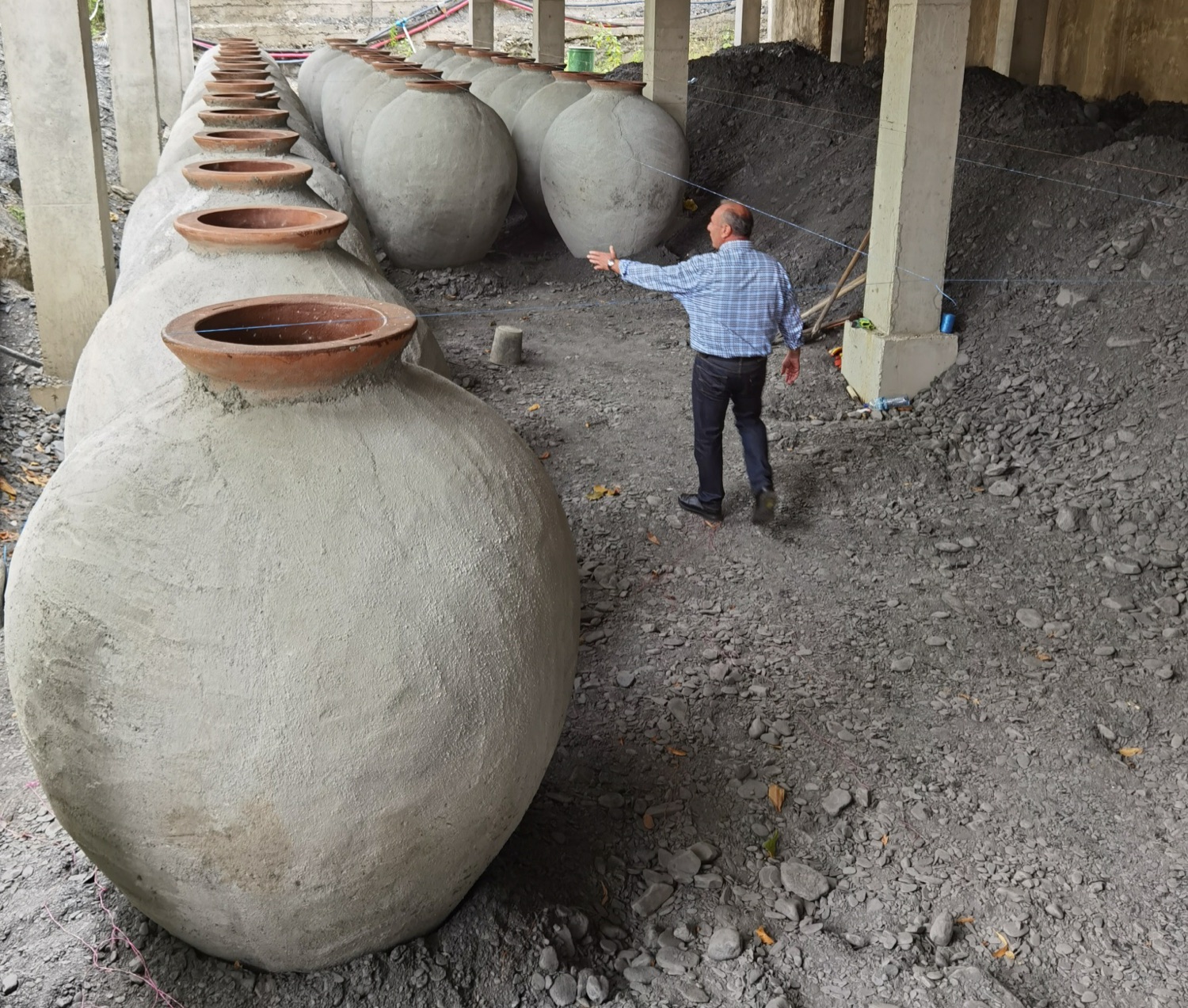
Today the vessels are buried up to the neck. How they are placed in the cellar is crucial, because they are difficult to get out again afterwards. First the pit is dug, then the qvevris are placed side by side, and finally the spaces between them are filled in again and a floor may be laid on top. All you can then see are the 'mouths' of the qvevris. Modern qvevris range from 100 to 3,500 litres. Many winemakers consider 1,000 to 1,200 litres ideal. Smaller vessels hold their temperature less well during fermentation, while in larger ones the fermentation can get too hot too quickly.
Traditionally the grapes are crushed in a satsnakheli, a hollowed-out tree trunk or a stone trough. The juice then goes into the qvevri together with the skins, pips and often the stems as well.
Fermentation usually starts spontaneously after two or three days, with wild yeasts, and lasts eight to twelve days. Over time the pips and skins sink to the pointed bottom of the qvevri, so the lowest part of the qvevri holds the wine with the most tannins. Many winemakers leave that bottom part in to make chacha (Georgian grappa) from it.
When fermentation is complete, the qvevri is sealed with a lid of stone or glass, made airtight with clay. Traditionally the wine stays on its skins like this until spring, so for about six months. The opening of the qvevri in spring is often accompanied by festivities. The wine is then separated from the skins and is sometimes aged for another year in a different qvevri.
This long skin maceration, six months or more, is what characterises the Kakhetian method. White wines made this way are called amber wines. They have a firm, tannic structure and develop aromas of apricot, orange peel and nuts. Winemakers steer the structure in different ways: some first dry the stems in the sun, others only use stems from the ripest grapes, and others leave them out altogether.
For red wines the method is similar, but the grapes are usually destemmed and the skin maceration is shorter, typically a month.
In Imereti and other West Georgian regions, skin maceration is shorter, usually about a month. Fewer stems are used here, because in these regions they usually do not ripen enough. The wine is therefore often fermented with only a third of the skins, and even more often without any at all. The wines from these regions are lighter and fresher as a result. Climate change is pushing alcohol levels up, though, so some winemakers are now actually adding more stems to give the wine extra structure.
Many winemakers are inspired by tradition but not bound by it. They experiment with different maceration periods, with or without skin contact, and with stainless steel tanks and oak barrels. Some even make rosé (a colour that has not really caught on in Georgia yet) and sparkling pét-nats in qvevri.
Cleaning qvevris is one of the biggest challenges in Georgian winemaking. The vessels are porous, fixed in the ground and hard to reach. After the solid remains have been removed, traditionally someone climbs into the qvevri to scrub the walls with brushes made of natural materials. The vessel is then rinsed with a solution of wood ash or slaked lime, and neutralised with water containing citric acid.
A new qvevri often gives good wine in its first year, but anyone who does not clean it carefully will run into more and more problems over the years. In addition, the grapes must be perfectly healthy and well selected. The warm climate, the lack of temperature control and the relatively low acidity make the wine prone to oxidation and spoilage.
Modern winemakers therefore increasingly use aids. Some lay water pipes around their qvevris to control the temperature, use stainless steel rods to punch down the skins, or fit lids with an airlock so that carbon dioxide can escape but no air can get in. High-pressure cleaners, UV lamps and a careful use of sulphur are also used, even by natural winemakers.
Making a qvevri is a craft passed down from father to son. Qvevris used to be made all over Georgia, but now there are only a few villages where this still happens, mainly in Kakheti and Imereti.
The clay is moistened, ground, mixed and shaped into long coils. No potter's wheel is used. The qvevri is built up layer by layer from the pointed base, which stands on a wooden tripod. Each coil of clay has to dry for two days before the next one can be added, so building a 1,000-litre qvevri takes about two weeks, and several vessels are always being worked on at the same time. The maker uses no measuring instruments and does everything by eye. The work is seasonal and runs from March to November.
After three to four weeks of drying, the qvevri goes into the kiln at a minimum of 1,100 degrees. Traditionally the temperature is judged by the colour of the smoke and of the clay, not with a thermometer. Firing is the trickiest step. If the temperature is too low, the qvevri becomes too porous, which can lead to leaks and even to a salty, earthy taste in the wine.



 Orange wine (31)
  Fresh (98)
  Light (37)
  Rosé (16)
  Aromatic (20)
  Medium (96)
  Sparkling (28)
  Ripe (70)
  Full-bodied (99)