


The Nahe is a small German wine region with vineyards along the river of the same name. The very varied soil composition in particular makes the wines from the Nahe interesting. Good Rieslings come from there, but Müller-thurgau and Silvaner also do well in the Nahe. Red is mainly made here from Dornfelder and Spätburgunder.
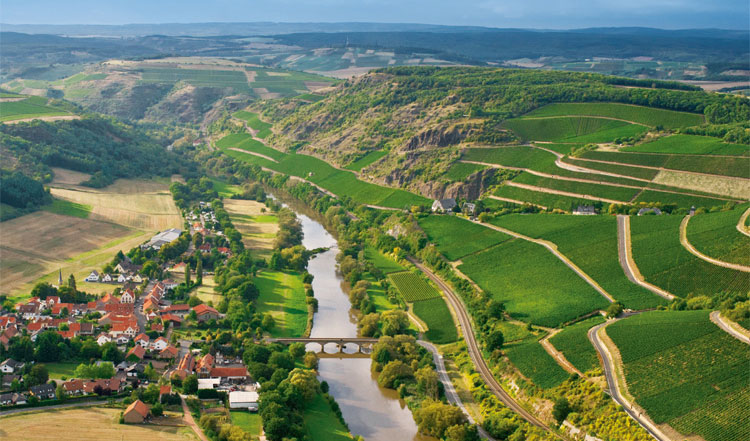
The Nahe is the little brother of the other wine regions in western Germany. The wines resemble the Mosel in terms of freshness and refinement. And they also have something in common with the wines from the Rheingau, the intensity and fullness. It takes some searching, but the Nahe also clearly has its own characteristics due to the geological evolution.
The Nahe region is named after the river 'Nahe'. The vineyards are spread along this river and its tributaries; both on rolling hills and on dramatically steep slopes. They are protected from the cold by the Soonwald and the Hunsrück mountains in the northwest, which means that the temperatures remain average. Not too much rain, enough hours of sunshine, in other words, fine.
But if you look a little further, or actually a little 'deeper', you will see that the soil in the Nahe is anything but homogeneous. Due to its volcanic past, the ground has been shaken up several times. In a relatively small area, you will therefore encounter different soil compositions. Approximately 180 soil types have now been discovered.
The Traisener Bastei, one of the most famous vineyards, is colored red by sandstone and porphyry. Riesling thrives here and gives the glass an abundance of minerality and spiciness. Just like around Schlossböckelheim, where an extra scoop of quartzite in the soil ensures tropical fruit elegance.
Müller-thurgau and Silvaner do well on the sandy loam in the north. More towards the Rhine in the northeast, the vines grow with their roots in weathered layers of clay, loess and loam. You will also find red wines there, mainly made from Dornfelder, Spätburgunder and a little Portugieser. The Nahe owes its personality to the soil, which is just as versatile as the wines it produces.



 Orange wine (27)
 Fresh (90)
 Light (36)
 Rosé (14)
 Aromatic (22)
 Medium (98)
 Sparkling (27)
 Ripe (71)
 Full-bodied (99)