


Guria lies in western Georgia on the Black Sea, between Samegrelo to the north and Adjara to the south. It has a subtropical climate and is the wettest region in the country. Guria has always been a modest wine area without large wineries. Even so, it has a number of remarkable indigenous grapes and a small group of winemakers who are seriously exploring the region's potential.
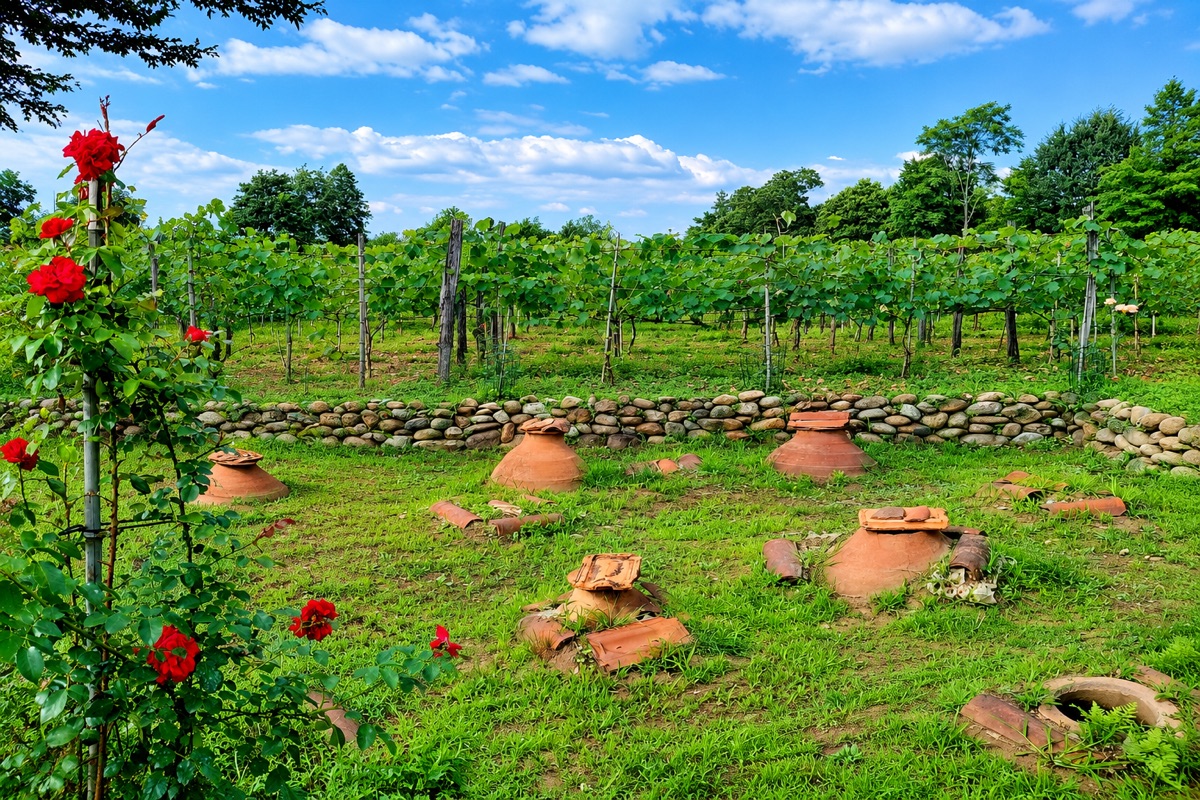
Along the coast Guria is flat and sometimes marshy, but inland it quickly turns into a maze of forested ridges, steep spurs and deep valleys. The region consists roughly of three parts. Ozurgeti in the south is closest to the sea and fairly flat. Lanchkhuti in the north was once known for its qvevri makers. Chokhatauri in the east is the hilliest, with the steepest slopes and the most wind. The best wines have always come from the sunny hills, not from the humid coastal strip. Along the coast, mainly grain, vegetables and tea are grown.
Although it is relatively cool, Guria is best known for its red grapes, such as Chkhaveri, Ojaleshi, Chvitiluri, Jani, Skhilatubani and Aladasturi. Wines from these Gurian grapes are usually light and lively, with little tannin and fresh acidity. Traditionally they ferment only briefly on the skins, often for no more than a week.
The best-known grape is Chkhaveri, a late-ripening variety with very high acidity. In the past it was often made into semi-sweet rosés that seasoned wine lovers like us are not exactly thrilled about. Fortunately, there are now also serious winemakers trying to make dry wines from Guria's grapes. Jani is attracting attention again too, as is the combination of Jani and Skhilatubani. Among the white grapes, Tsolikouri from Imereti is planted because it is fairly resistant to fungal diseases, a very useful trait in relatively humid Guria. Other old Gurian varieties are being replanted in small quantities by pioneering winemakers.
Traditionally the vines grew up trees, a method that produced plenty of grapes but not high quality. The serious winemakers now experimenting in the region have moved away from this. Some keep the tall vines but train them on wires, so that the grapes get enough sun and air and yields stay low. There are still only a handful of serious wine businesses in Guria. The renewal is coming from a small group of passionate growers who combine old knowledge with modern insights. Whether this will lead to great wines remains to be seen, but the foundations have been laid.



 Orange wine (31)
  Fresh (98)
  Light (37)
  Rosé (16)
  Aromatic (20)
  Medium (96)
  Sparkling (28)
  Ripe (70)
  Full-bodied (99)