


South African wine has been on the rise since the nineties. They are popular in the Low Countries, partly because we finally come across wines whose labels we can read. After the market has been flooded with cheap South African bulk wine in recent years, we have been receiving more and more South African quality wines from small producers who express the terroir of their vineyard in the character of the wine. We have made a selection of such small quality producers.
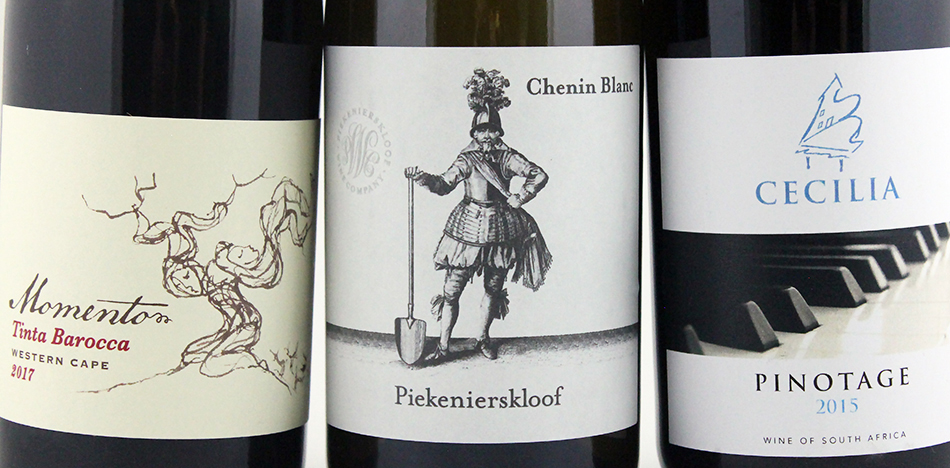
South African wine history has a clear beginning. The first wine harvest was on 2 February 1659. Some time earlier, the Dutchman Jan van Riebeeck of the VOC had ordered a settlement to be built at the Cape of Good Hope. He planted grapevines to supply the passing ships. Even more important was his successor Simon van der Stel. Van der Stel was more of a (wine) farmer than a governor. He planted several vineyards and made South African wine his life's work. The most famous South African wine district Stellenbosch is named after him.
During the Apartheid era, the import of wine from South Africa was prohibited. It was not until the 1990s that South African wines appeared on the market again. Much has changed since then. Not only in terms of technology, but also socially. Wine growing is no longer the preserve of a white elite. There is a whole new and diverse generation of winemakers active in South Africa. Over the years, South African wine has become very popular in Western Europe and in the Netherlands in particular. In all fairness, it must be said that the vast majority of (cheap) South African wine drunk by the Dutch is shipped in large tanks and bottled in the Netherlands under names that they have never heard of in South Africa.
In recent years, we have seen more and more small winemakers who make wine on a small scale in a sustainable way and strive for typicity and terroir expression. In other words: wines that you can taste where and from what they were made. These are the better South African wines that often have a European feel in terms of style and which naturally carry a somewhat higher price tag.
There are dozens of wine grapes planted in South Africa. Most are well-known international varieties from the European continent, some are crosses from the United States or from South Africa itself. One of these local crosses has become one of the country's 'signature grapes': Pinotage. This is a cross between Pinot Noir and Cinsault. Approximately 6% of South African vineyards are now planted with Pinotage. You can find it in almost all wine regions. In the past, the quality of Pinotage wines sometimes left something to be desired. This was not due to the grape, but to diseases in the vineyards. With the help of the South African 'Pinotage Association', the quality has improved considerably in recent years.
For white wines, Chenin Blanc is the most widely planted; almost a fifth of South African vineyards are planted with this grape - which is also called 'steen' in South Africa. In second place (with a planting of approximately 12%) is Colombard, followed by Sauvignon Blanc and Chardonnay, both with slightly less than 10%. Sauvignon Blanc has been gaining ground in recent years at the expense of Chardonnay. Other white grape varieties that are made into wine in South Africa are: Emerald Riesling (which you can also find in Israel and the United States), Gewürztraminer, Marsanne, Grenache Blanc, Chenel (a local cross between Chenin Blanc and Ugni Blanc), Muscadelle, Roussanne, Sémillon (also called 'Green Grape' in South Africa), Ugni Blanc, Clairette Blanche, Muscat of Alexandria (used mainly for dessert wines), Riesling, Pinot Gris and Viognier.
When it comes to red wines, Cabernet Sauvignon is the most widely planted with over 11%, closely followed by Syrah. The latter is now making a strong comeback and could easily be the most widely planted grape in South Africa in a few years. In third and fourth place respectively are Pinotage (7.5%) and Merlot (6%). Other varieties found in South Africa include: Cabernet Franc, Malbec, Mourvèdre, Ruby Cabernet (a Californian cross between Carignan and Cabernet Sauvignon), Tinta Barocca, Touriga Nacional, Sousão (these three are traditionally used for sweet, fortified wines but are increasingly being pressed into dry wines), Barbera, Carignan, Gamay, Nebbiolo, Petit Verdot, Pinot Noir, Sangiovese, Zinfandel, Cinsault, Grenache and Roobernet (a local cross between Cabernet Sauvignon and Alicante Bouschet).
The South African wine industry currently has its own preferences. Just as you can spot the 'big five' in the Kruger Park, there is a 'bix six' that the wine industry focuses on: Pinotage, Shiraz, Cabernet Sauvignon, Merlot, Chardonnay and Sauvignon Blanc.




 Orange wine (31)
 Fresh (95)
 Light (35)
 Rosé (17)
 Aromatic (21)
 Medium (99)
 Sparkling (32)
 Ripe (72)
 Full-bodied (95)