


Switzerland is perhaps the least known wine country in Western Europe. Wine has been produced here for a long time. Good wine even. From beautiful vineyards and often from unique grape varieties. And yet we know almost nothing about Swiss wine in our region. The reason is simple. Barely one percent of Swiss wine crosses the border. The Swiss are thirsty, they drink everything themselves. All the more reason to discover Swiss wine, because this country still has many beautiful wine secrets.
Traditionally, the Swiss drink almost all of their country's wine themselves. There is little desire among winemakers to export their wines, there is simply no need. In fact, the Swiss import almost half of their consumption because national production is not enough to quench the national thirst. And if a bottle does slip across the border, it is often quite expensive. As is often the case in prosperous Switzerland. This has to do with high land prices and very labor-intensive, steep vineyards. Swiss winemakers know that they cannot produce cheap wine, even if they wanted to. That is why they are investing heavily in wines with a story, of high quality and with a ditto price.
That is a shame - for us - because there is much beauty to discover in Switzerland. For example, there are approximately 200 (!) different grape varieties. Many of them can only be found in Switzerland. They grow on steep vineyards along the Rhine, which rises in Switzerland, and especially along the Rhône. Some of the Swiss vineyards are among the highest vineyards in Europe. These are vineyards that enjoy a lot of sun and have a very unique terroir that is very suitable for wine growing. Ingredients for high-quality wines.
About 80% of the wines are made in the west of the country, in particular in Valais (in Dutch: Wallis), Vaud and around Lake Geneva. The vineyards are located on the north side of the Rhône with the slope facing south. In the south of Switzerland, near the border with Italy, lies Ticino, the fourth largest region in the country in terms of production volume. In the north and east you will find less prominent wine regions such as Thurgau, Aargau, Basel, Neuchâtel and Zurich.
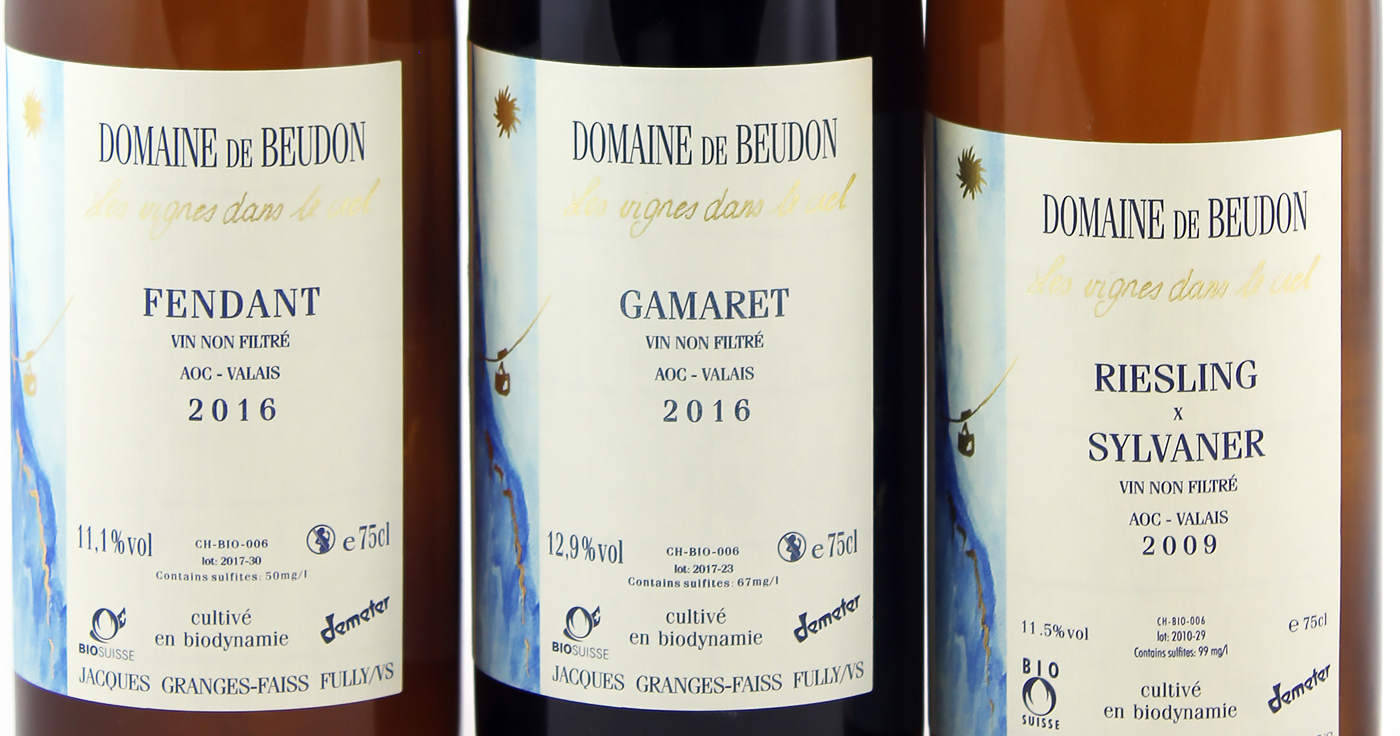
The Swiss prefer to drink red rather than white. That is why the number of vineyards with blue grapes has grown in recent decades at the expense of white wine. The most important grape for red wines is the Pinot Noir, which is often called Blauburgunder here. The Swiss also like Gamay. In the southern Ticino, the Merlot is the local blue star. And then there is a procession of local varieties such as Humagne Rouge (Cornalin) and Bondola, and so-called hybrid varieties such as Gamaret, Garanoir, Diolinoir and Carminoir.
For white wines, the Fendant grape - also known as Chasselas or Gutedel - is important in Switzerland. Usually this grape, which you also find in the French Savoie and for example in Germany under the pseudonym Gutedel, gives fairly neutral vineyards. In Switzerland they know how to press particularly fascinating examples that are anything but neutral on your taste palette. Local varieties such as Petite Arvine, Amigne, Humagne Blanc, Completer, Païen, Räuschling, Elbing, Rèze and even Solaris.




 Orange wine (31)
 Fresh (95)
 Light (35)
 Rosé (17)
 Aromatic (21)
 Medium (99)
 Sparkling (32)
 Ripe (72)
 Full-bodied (95)