


Romanian vineyards are spread across the country. White wines come mainly from the North, red wines mainly from the South. There are a few large wine regions, divided into smaller wine districts, which are more important for the indication of origin.
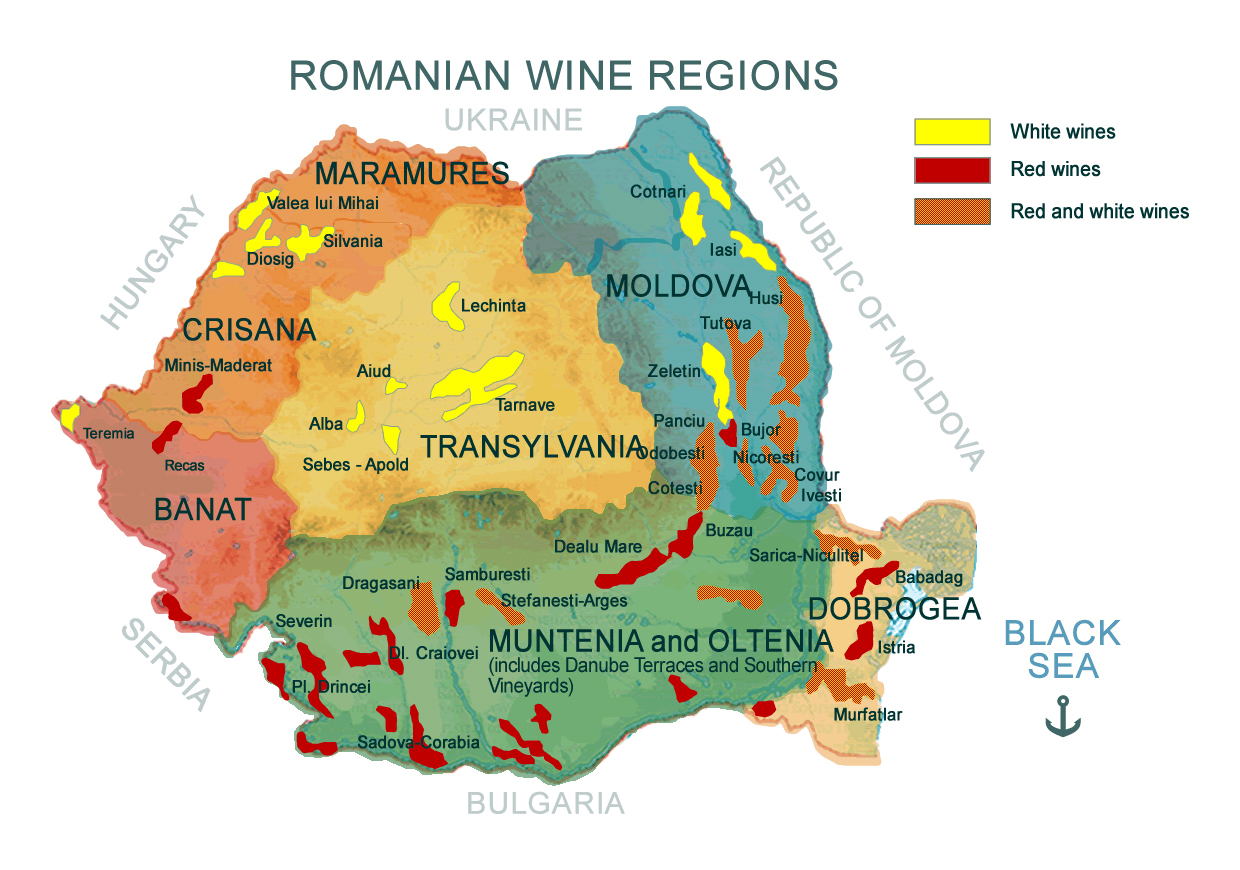
On the steep slopes in the mountainous centre of Romania, fresh, often lightly perfumed white wines are produced. Many Saxons settled in Transylvania in the Middle Ages. They brought with them Central European grape varieties such as Pinot Gris, Welschriesling, Furmint and Muskat Ottonel. Sauvignon Blanc and Chardonnay are also fairly widespread. Tarnave is considered the most important wine district in Transylvania.
In the province of Moldavia (not to be confused with the country of the same name), dry and sweet wines with spicy aromas have been produced since time immemorial. In the early Middle Ages, King Stefan cel Mare had bridges and roads built specifically to transport the famous wine abroad. Famous wines have exotic names such as Busuioaca de Bohotin, Galbena and Odobesti. Wine is made from well-known French grapes but also from Fetească Neagră and from the rather obscure Novac, Şarbă and Negru de Drăgăşani. A famous dessert wine of the same name is produced in the Cotnari district.
The vast, flat South of Romania is best known for its red wines. Most of the country's vineyards are located here. Cabernet Sauvignon, Merlot, Pinot Noir and Sauvignon Blanc are grown on a large scale. Indigenous grapes such as Fetească Neagră, Fetească Albă and Tămăioasă Romaneasca (Muscat Blanc à Petits Grains) are also popular. The latter is used to make a famous Romanian sweet Muscat wine.
This province is located on the Black Sea coast. Murfatlar is the most important district. Although dry and semi-sweet red wines from Cabernet Sauvignon and Pinot Noir are also widely available, the region specializes in late-harvest sweet wines. The sun shines abundantly, while the Black Sea provides cooling. Ideal conditions for so-called noble rot. The most famous sweet wine from Murfatlar is the very sweet Hemakat.
In the 18th and 19th centuries, the wines from Banat enjoyed great fame at the court of the Viennese emperor. Here, among other things, lie the ancient Recas vineyards and the famous, originally Hungarian Miniş vineyards. In 1862, Rosu de Miniş won first prize at an international wine competition in London. At that time, wines from these vineyards were exported to England, the Netherlands, Germany and even the United States.
Excellent red wines are made in the beautiful, unspoiled nature of northeastern Romania, mainly from Kadarka, Cabernet Sauvignon, Pinot Noir and Merlot. Many ethnic Hungarians live in this part of Romania and their influence on the wine culture is visible. Welschiesling, Burgund Mare, Feteasca Regala, Furmint, Pinot Noir, Muskat Ottonel and Fetească Albă are also common. In general, the red wines of Kadarka and the white wines of Furmint are considered the best wines of the region.



 Orange wine (31)
  Fresh (95)
  Light (34)
  Rosé (17)
  Aromatic (20)
  Medium (97)
  Sparkling (30)
  Ripe (72)
  Full-bodied (96)