


Hungary has fourteen recognised wine districts, from the world-famous sweet Tokaj to the red Bull's Blood wines of Eger. A country with a centuries-old wine tradition and a great diversity of native grape varieties.
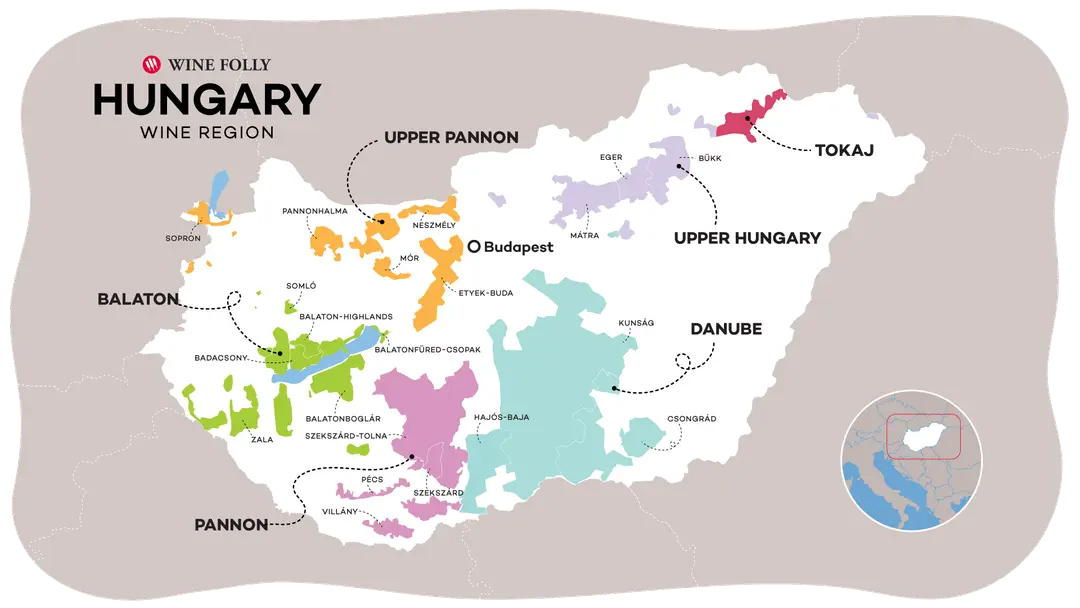
Below we describe the main Hungarian wine regions in alphabetical order. In the text you will find links to pages with more information about the various wine regions.
The vineyards of Ászár-Neszmély lie along the winding Danube, near Hungary's northern border. The wine district shot onto the wine map in 1998, when the Hilltop winery won the award for 'Best white wine of the year' in Great Britain with its Chardonnay. The terroir is well suited to fresh, aromatic and elegant white wines.
Wine has been made around Hungary's Lake Balaton since the start of our era. The lake provides cooling and reflects sunlight onto the vineyards. The climate and volcanic soil create a distinctive terroir. Winemakers here produce mainly white wines. Five different wine districts lie around the lake: Badacsony, Balatonfelvidék, Balatonboglár, Balatonfüred-Csopak and Zala.
The wine regions of Bükkalja and Mátraalja are two lesser-known Hungarian wine regions, directly east and west of their big brother Eger. Mátraalja is by far the larger of the two and is best known for its spicy white wines; Bükkalja is still an emerging region.
The Eger wine district is often compared to French Burgundy, but Eger has many more different grape varieties planted. From these, the winemakers produce their famous 'Bull's Blood' (Egri Bikavér). Since the fall of the Wall, Eger has enjoyed a second youth, and the quality of the region has advanced rapidly. In 1995, 1998, 2005 and 2009, Eger produced Hungary's winemaker of the year.
The Etyek-Buda wine district lies close to the capital Budapest, where wine has been made for centuries. The region enjoyed its greatest fame in the 19th century, when it supplied the Austro-Hungarian Empire with its sparkling wines – this Hungarian 'champagne' was world-famous. Today, alongside sparkling wines, plenty of crisp, fresh still white wines are also made.
In the north of Hungary, in the beautiful valley between the Vértes and Bakony hills, lies Mór. This Hungarian wine district is one of the smallest and least known in the country. It is the home of the Ezerjó grape, which produces firm, fresh white wines.
The Pannonhalma wine district, Hungary's second-smallest, is best known for the ancient Benedictine monastery on its central hill, which has made good wine for a thousand years: Pannonhalmi Apátsági. Nowadays the monks have handed winemaking over to professional oenologists.
Although the small Pécs wine district in southern Hungary, with only 600 hectares of vineyards, is barely known outside Hungary, winemaking there is anything but new. Already in Roman times, Pécs was known as the gateway to the Balkans, where various trade routes met. In the nineteenth century, white grapes were grown here for the Hungarian 'champagne' that was made in Budapest and supplied the Austro-Hungarian Empire with its sparkling wines.
The vineyards of the small Hungarian Somló wine district lie on and around the flanks of an extinct volcano. Since the Middle Ages, the wines of Somló have been credited with medicinal properties: they were said to boost fertility. Habsburg princes drank wine from the Juhfark grape from Somló on their wedding night – it was supposed to guarantee the birth of a son.
The Sopron wine district, on the border with Austrian Burgenland, is important for red wines. The vineyards lie on the shore of Lake Neusiedl and at the foot of the Alps. The Kékfrankos grape is the star performer – this grape has put Sopron back on the wine map after a century of silence.
In the nineteenth century, Franz Schubert and Franz Liszt were among the many celebrities who drank red wine from Szekszárd at parties in Vienna. Schubert is even said to have owed the inspiration for his famous trout Quintet to it. In 1865 he gave a bottle to Pope Pius IX, who declared: 'This wine from Szekszárd promotes my health and my spirit.'
The oldest wine appellation in the world is not in France, but here in eastern Hungary. In the seventeenth century, the French king Louis XIV dubbed his favourite sweet Tokaji wine 'Wine of Kings, King of Wines' – Hungarian Tokaj was the most expensive wine in the world at the time. In recent years, dry white wines from Tokaj have been on the rise, with dry Furmint the most popular. Another trend is Late Harvest Tokaji: a freshly made noble-sweet wine from late-harvested grapes.
The Tolna wine region has only been independent since the end of the last century. It lies on the border between 'white and red': in the north, close to Lake Balaton, white wines are made, while in the sunny south red wines dominate. Tolna is young and energetic, and the quality of the wines keeps improving.
The Villány-Siklos wine region is one of the finer ones in Hungary. Vibrant, spicy red wines are made here from the dark-skinned grapes Portugieser, Kadarka, Cabernet Franc and Kékfrankos. Hungary's Winemaker of the Year has come from Villány-Siklos on several occasions – this wine region accordingly enjoys a strong reputation both within and beyond Hungary.



 Orange wine (30)
 Fresh (93)
 Light (35)
 Rosé (16)
 Aromatic (20)
 Medium (99)
 Sparkling (31)
 Ripe (72)
 Full-bodied (94)