


Austria has nineteen recognised wine districts, from the famous Wachau along the Danube to Styria in the south. Grüner Veltliner and Riesling are the best-known white grapes, with Blaufränkisch for the red wines of Burgenland.
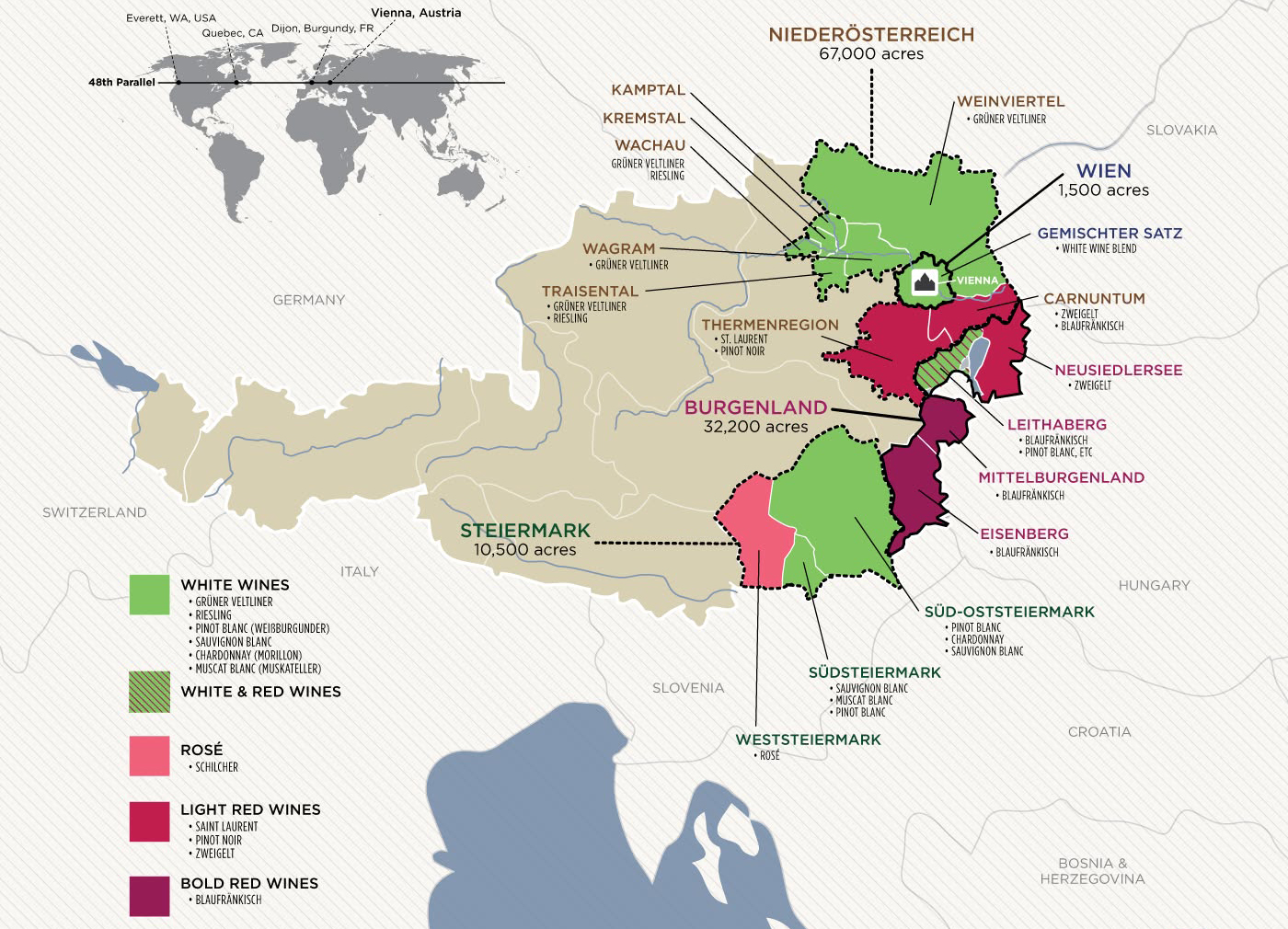
Below we describe the main Austrian wine regions in alphabetical order. In the text you will find links to pages with more information about the various wine regions.
In Burgenland, just below Vienna, Lake Neusiedl creates a microclimate that is ideal for viticulture. The vineyards on the marshy soils around the lake offer good conditions for noble rot. The dry white wines from Burgenland are fresh and lively, the reds elegant and fruity.
It is mainly the Blaufränkisch grape that has given Mittelburgenland its reputation as an Austrian wine district for red wines. It is planted here on a large scale and produces characterful red quality wines.
The Austrian Neusiedlersee wine region lies between the lake of the same name and the Hungarian border. Beautiful noble-sweet wines are made here: the shallow lake warms up considerably in summer, and in the mornings the water is warmer than the cool air, sending mist drifting over the vineyards. The grapes become porous, lose water and shrivel – leaving honey-sweet grape juice behind. But that is not all: more and more winemakers are also producing stylish, dry quality white and red wines.
No wine district in Austria offers such an enormous variety of grape varieties and wine styles as Neusiedlersee-Hügelland. The soil on the Leithaberg ridge contains granite, slate, limestone and prehistoric rock. The vines draw their water from this mineral-rich soil.
The beautiful, gently rolling landscape of Südburgenland is one of the least-known Austrian wine districts. The Blaufränkisch grape is very important here. Although it is the largest district of Burgenland by area, there are still fewer than 500 hectares of vineyards. Many vineyards are tended by 'part-time' Austrians – hobbyists who sell their wine in so-called Buschenschanken: typical Austrian wine taverns where you can buy the wines of the region.
The Austrian Carnuntum wine district lies east of Vienna, against the Slovak border, and dates back to Roman times. The soil – rich in loam, limestone and loess –, the abundant sunshine, shelter from the Leitha range and the warm wind from the north Hungarian plain provide fine conditions for red wines. Most are sold under the name Rubin Carnuntum.
The vineyards in the Kamptal owe their name to the river Kamp, which runs right through it. It is one of the most prestigious Austrian wine districts: some of the finest Rieslings and Grüner Veltliners are made here. The vineyards lie mainly on terraces along the steep banks of the river.
Three different climate zones, spicy Grüner Veltliners, delicate Rieslings, fruity Pinot Blancs and a handful of beautifully made light red wines: that is what the fine Austrian Kremstal wine district has to offer. The wines come in two quality tiers: the classic, fresh-fruity white wines and the richer, fuller Reserves. The latter rank among the absolute top of Kremstal and can often be kept longer.
The Niederösterreich wine region is the largest in the country, in the northeast of Austria. Many vineyards lie on steep slopes along the Danube, amid baroque monasteries and picturesque villages. The Grüner Veltliner and Riesling from Niederösterreich are world-famous.
The mountainous Steiermark (Styria) wine region lies in the south of Austria and is the only Austrian wine region with a Mediterranean climate. Mainly white wines are made here; the volcanic soils make them particularly mineral-driven. The Sauvignon Blancs rank among the best in the world.
The Südost-Steiermark (southeast Styria) wine district is small and very hilly. The vineyards lie on the flanks of the many hilltops – once volcanoes. The fertile volcanic soil gives the wines a recognisable, mineral character. Most are sold in Buschenschanken or straight from the cellar, and only a small share is exported. A shame, since lovely wines are made here from a wonderful diversity of grapes.
It is by no means widely known here, but the Austrian Südsteiermark (south Styria) wine district enjoys an internationally renowned reputation for zesty Sauvignon Blancs and mineral Chardonnays, known here as Morillon. They can rival the finest examples from France.
The Weststeiermark (west Styria) wine district, with barely 500 hectares of vineyards, is the smallest in the Styria region. Weststeiermark is famous above all for a wine made only here: the Schilcher, a bone-dry rosé from the Blauer Wildbacher grape.
The Thermenregion wine district has unique grape varieties found nowhere else in the world – above all Rotgipfler and Zierfandler. Viticulture was probably introduced here by the Romans around the start of our era: they had a large legionary base in nearby Carnuntum, and vineyards were planted for miles around to supply the soldiers with the noble drink.
The Traisental region has only been an independent wine district since 2006, but wine was already being made here in the Bronze Age. More than half the vineyards are planted with Grüner Veltliner: fruity, slightly spicy, mineral and with fresh acidity.
Over millions of years, the Danube has carved the landscape of the Wachau dozens of metres deep. The vineyards lie on the steep riverside slopes; walk down from the slope and you encounter layers of mineral rock with granite, quartz feldspar, mica and gneiss, but also sand that was blown here by the wind towards the end of the Ice Age, forming a thick layer of loess. This diversity of soil and the steep riverside location make the terroir of the Wachau highly interesting.
The Austrian Wagram wine region is – by Austrian standards – a fairly large wine area with almost 2,500 hectares of vineyards, split between a small strip of land just south of the Danube and a much larger part to the north of the river. Wagram produces mainly white wines.
The Weinviertel is Austria's largest wine region. It lies in a beautiful landscape between the Danube and the Czech border, in the far northeast of the country, with a fascinating variety of grape varieties and styles. Winemakers produce plenty of peppery Grüner Veltliner, but also red wines from Zweigelt, Pinot Noir, Blaufränkisch and Blauburger.
As the only capital city in the world, Vienna is an independent wine district. As early as the early Middle Ages, vineyards extended right up to the city walls; today they lie scattered across the hilly outskirts. Visiting Vienna? Then seek out a traditional Viennese Heuriger: small wine taverns dotted across the city among the vineyards, where you can taste the local harvest.



 Orange wine (31)
 Fresh (95)
 Light (35)
 Rosé (17)
 Aromatic (21)
 Medium (99)
 Sparkling (32)
 Ripe (72)
 Full-bodied (95)