


Luxembourg is one of the smallest and coldest wine countries in the world. The vineyards are located on the west side of the river Moselle, on the border with Germany. Luxembourg wine is usually white, often sparkling and crisp. You have to like it a bit. They taste best in the summer. As pure, not too alcoholic thirst quenchers.
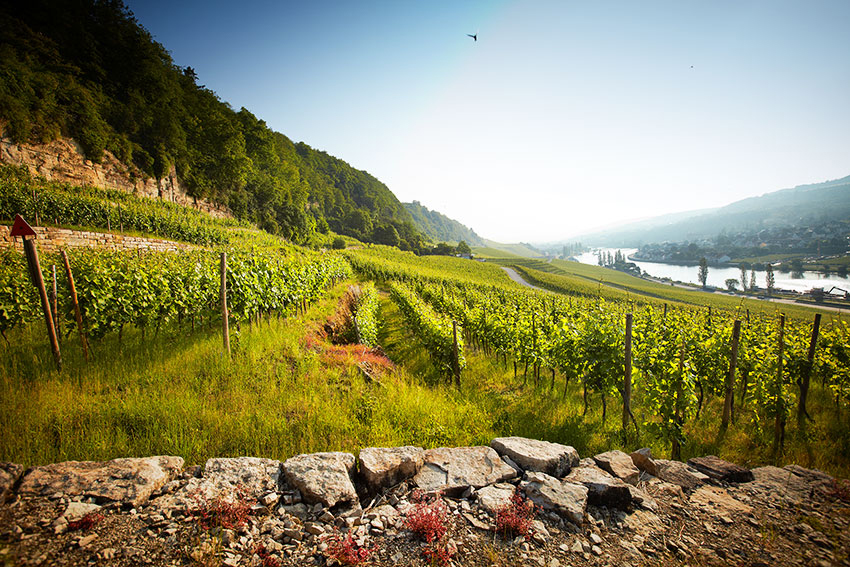
Luxembourg may be a small wine country, but it is certainly not a new wine country. The Romans were already making wine here 2,500 years ago along the steep Luxembourg banks of the Moselle. The cool climate does not always make it easy for winemakers. There is relatively a lot of rain and parts of the harvest can sometimes be lost due to night frost. Not to mention the work on the sometimes very steep slopes. Export is low, Luxembourgers like to drink their wine themselves. The total Luxembourg wine-growing area covers approximately 1,300 hectares. The Luxembourg wine regions are located in a long strip along the Moselle river.
Most Luxembourg wines are white and often sparkling (Crémant de Luxembourg). They are made in a strict style, with relatively little alcohol and fresh acids. Red is scarce, and usually made from Pinot Noir. In terms of grape varieties, Luxembourg resembles the nearby Alsace in France and the Mosel in Germany. You will find Riesling, Pinot Blanc, Pinot Noir and Pinot Gris there. The Rivaner (also known as Müller-thurgau) is the most widely planted grape in Luxembourg. It guarantees a high yield per hectare and provides the inhabitants of the Grand Duchy with their fresh table wines. The Auxerrois is a grape that you will typically find in Luxembourg. In this cool climate, the Auxerrois does remarkably well and produces fresh, slightly aromatic wine. The Elbling is also a grape that distinguishes Luxembourg. In the past, this was the most widely planted grape in the entire region, but you will hardly find it in Germany anymore. The Elbling produces light, lemon-fresh white wines in Luxembourg.
The trend in Luxembourg in recent years has been to produce fuller wines. Pinot Gris and increasingly Gewürztraminer grapes are mainly used for this. Quite a challenge in this cool climate. Fortunately, winegrowers are allowed to chaptalize in the coldest years (add sugars) to give the wine a bit more breadth.
Despite their small vineyard area, Luxembourgers have a full-fledged classification system, although it does have some shortcomings. Almost all wines have (the same) Appellation Contrôllée Moselle Luxembourgeoise. As a consumer, that doesn't make you much wiser. Luxembourg wines are tested in a laboratory and tasted by a panel. The best wines are allowed to put Vin Classé, Premier Cru or Grand Premier Cru on the label. But make no mistake, these are also fairly light, crisp white still or sparkling wines.
The cold climate can cause headaches for Luxembourg winemakers; every disadvantage has its advantage. For about fifteen years, the winemakers have been experimenting with Ice wines and Vins de Paille (sweet wine made from dried grapes). They do this with Auxerrois and Riesling, among others. The results are very nice.




 Orange wine (31)
 Fresh (95)
 Light (36)
 Rosé (17)
 Aromatic (21)
 Medium (99)
 Sparkling (32)
 Ripe (72)
 Full-bodied (96)