


The Czech Republic is one of the least known wine countries in Europe. Wine has been produced there since the early Middle Ages. Especially in southern Moravia, on the border with Austria. There are many similarities with that country, such as the grapes that are used. The climate is relatively cool and therefore you can consider Czech wines as cool climate wines. And there is a lively scene of natural wine makers.
Vine growing was introduced to the present-day Czech Republic by the Romans in the fourth century. In the Middle Ages, Bohemian wines from the Prague area were even quite famous in Europe. There are many similarities with Austria. Historically speaking, this is not so strange, as both were part of the same empire for centuries. Moreover, Czech wine is mainly produced in southern Moravia, on the border with the Austrian wine district of Weinviertel.
However, when the Czech Republic disappeared behind the Iron Curtain, wine growing went into decline. Today, efforts are being made with great dedication and passion to revive the 19,000 hectares of vineyards. Slowly and steadily, the image of the Czech Republic, which is known for 'beer', is being enriched by wine. The production of relatively high-quality wine is still in its infancy, but it has started to come in recent years. It also helps that the Czechs, the largest buyers of wine from their own country, are becoming more critical and increasingly demanding higher quality.
Three quarters of Czech wines are white. The popular white grapes can also be found in the nearby Austrian vineyards: Ryzlink Vlasšký (Welschriesling), Ryzlink Rýnský (Rhine Riesling), Müller-thurgau, Veltlínské Zelené (Grüner Veltliner), Rulandské Bílé (Pinot Blanc) and Tramin Červiný (Roter Traminer). In the second half of the last century, the Czechs experimented vigorously with crossing all kinds of grape varieties. The disease-resistant, striking Malveria is a result of this.
The red wines from the Czech Republic are usually soft and elegant. The red Czech wine is also made from grapes that we mainly know from Austria: Svatovavřinecké (St. Laurent), Zweigelt, Modrý Portugal (Portugieser), Frankovka Modra (Blaufränkisch) or Rulandské Modré (Pinot Noir).
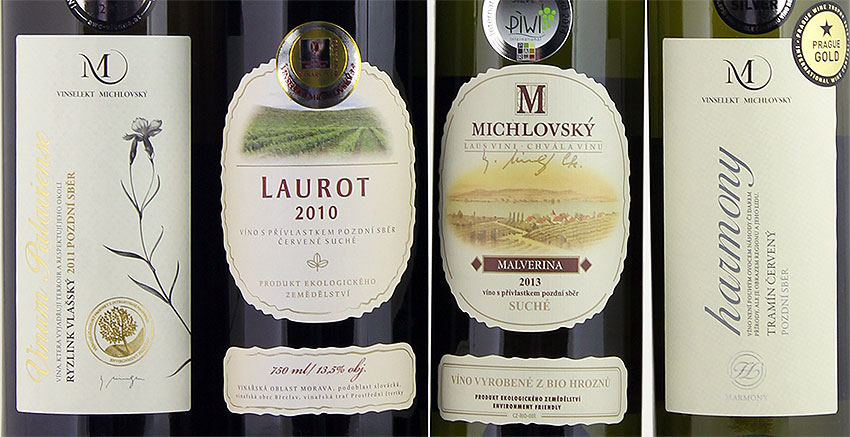
The former Czechoslovakia has pursued an active policy of crossbreeding grapes. The efforts were mainly focused on breeding disease-resistant grapes that made pesticides redundant. This has produced some typical Czech grapes. The best known is the blue André, like the Zweigelt a crossbreed between Blaufränkisch and St. Laurent. But what is the 'father' of Zweigelt is the 'mother' of André and vice versa. A relatively unknown white Czech cross is the Malverina, created by Czech winemaker/biologist Michlovský, who also bred the Laurot grape. The Cabernet Moravia is the 'Czech Cabernet', a cross between Cabernet Franc and Zweigelt.




 Orange wine (32)
  Fresh (97)
  Light (36)
  Rosé (17)
  Aromatic (21)
  Medium (98)
  Sparkling (30)
  Ripe (70)
  Full-bodied (99)