


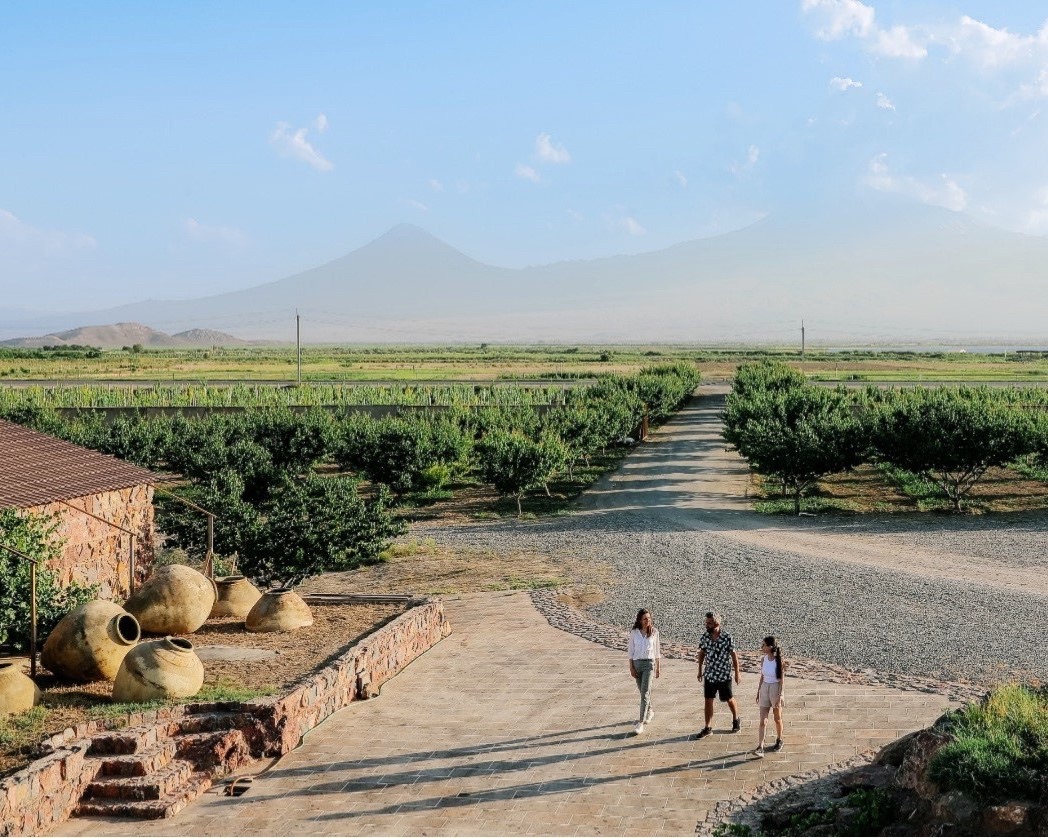
Tushpa is a small family winery owned by the Manasserian family in the Ararat Valley in Armenia. The vineyards lie at the foot of the biblical Mount Ararat. The winery was founded in 1992, shortly after the collapse of the Soviet Union. Tushpa is one of the wineries that have breathed new life into modern Armenian winemaking. They work mainly with Armenian grapes, including Haghtanak, an indigenous red grape that would almost have disappeared without this winery's efforts. The wines are made with as little intervention as possible and mature in stainless steel or in 'karas', the traditional Armenian clay vessels.
Armenia has one of the oldest wine traditions in the world. In 2007 a winery some 6,100 years old was discovered in a cave near the village of Areni, the oldest known to date. Archaeologists found fermentation vessels, a wine press and storage jars there. In neighbouring Georgia, traces of winemaking 8,000 years old have been found, but not a complete winery.
The name of the winery refers to the family's history. Tushpa is the ancient name of the city of Van, now in eastern Turkey and once the capital of the kingdom of Urartu. The Manasserian family's ancestors lived in Van until the Armenian genocide, more than a century ago. The great-grandfather of the current generation made wine there for his own use. Founder Mihran Manasserian grew up with stories of that time and named the winery Tushpa in tribute to his ancestors.
After his studies Mihran worked in Soviet wine and brandy factories. In the Soviet era, Moscow required Armenia to focus on brandy, and many vineyards of wine grapes were replaced by high-yielding brandy grapes. As a result, many grape varieties were in danger of disappearing. Mihran asked farmers in the area to keep their wine grapes and promised he would always buy their harvest. The family still keeps that promise: alongside its own vineyards, Tushpa buys grapes from these farmers.
In 1992 Mihran bought a plot of fallow land in the village of Taperakan. It was a hard time: Armenia was suffering from shortages of energy and food. Because all his money had gone into the land, he first distilled grape brandy to generate income. The first wines did not reach the market until 1999.
The Tushpa winery is in the small village of Taperakan, in Ararat province, some 35 kilometres south-west of the capital Yerevan and close to the famous Khor Virap monastery. From the winery you look out over the vineyards to the snow-capped Ararat on the horizon. The mountain lies across the border in Turkey, but is a national symbol for Armenians.
The winery has 6 hectares of vineyards at almost 800 metres above sea level. The soil consists of clay with sedimentary and volcanic rock. The climate is sunny and dry, with cool mountain winds. During the harvest the temperature ranges from 12 degrees at night to 30 degrees during the day. The family farms organically and uses water sparingly.
Mihran's children Abraham, Ani and Karlen have modernised the winery in recent years and developed the current range of wines. Abraham is the winemaker. The winery produces around 50,000 bottles a year and exports small quantities to a number of countries, mainly to specialist shops. One moment the family is proud of is when a Tushpa wine was presented to Pope Francis.
The estate's own vineyards are planted with Haghtanak, Kangun and Muscat grapes. Haghtanak, Armenian for "victory", was developed in the Soviet era by the Armenian breeder Ajvazjan, who mainly bred grapes for brandy. Haghtanak was an experiment that received little attention; Tushpa has now made it its calling card. Kangun, a white grape, was also developed in Armenia in the twentieth century.
The red wines ferment spontaneously, with wild yeasts. The winery wants to express the terroir as faithfully as possible and therefore intervenes as little as possible. The Haghtanak comes in a young version and as a Reserve, which matures for about six months in barrel. Tushpa also makes a white Kangun, a Muscat and brandy.
In 2024 the family launched 'Tushpa x Lab', an experimental side label. Where Tushpa stands for tradition, Tushpa x Lab explores rare Armenian grapes and new methods, above all naturally sparkling wine made by the old méthode ancestrale (pét-nat) from rare grapes such as Lalvari, Banants and Tozot. Armenia has some two hundred indigenous grape varieties, and with this label Tushpa wants people to taste as many of them as possible.
The winery is open to visitors all year round, seven days a week. There are tours and tastings, and visitors can eat Armenian dishes there, including freshly baked lavash, the traditional Armenian flatbread. We currently have two wines from Tushpa Winery in our range. You can view all our wines from Tushpa Winery here.
If you want to know more about this winery, here you will find the link to the website of Tushpa Winery.



 Orange wine (31)
  Fresh (99)
  Light (37)
  Rosé (17)
  Aromatic (20)
  Medium (97)
  Sparkling (29)
  Ripe (71)
  Full-bodied (101)
