


Racha-Lechkhumi lies in north-western Georgia, high in the mountains along the upper reaches of the Rioni river. Administratively, Racha and Lechkhumi form a single region, which is why they are always mentioned in the same breath. In winegrowing terms, however, they are really two separate areas, each with its own wine culture. Historically the area is best known for two semi-sweet wines with a protected designation of origin: the red Khvanchkara from Racha and the white Tvishi from Lechkhumi. Today, more and more winemakers are showing that excellent dry wines can also be made in Racha and Lechkhumi.
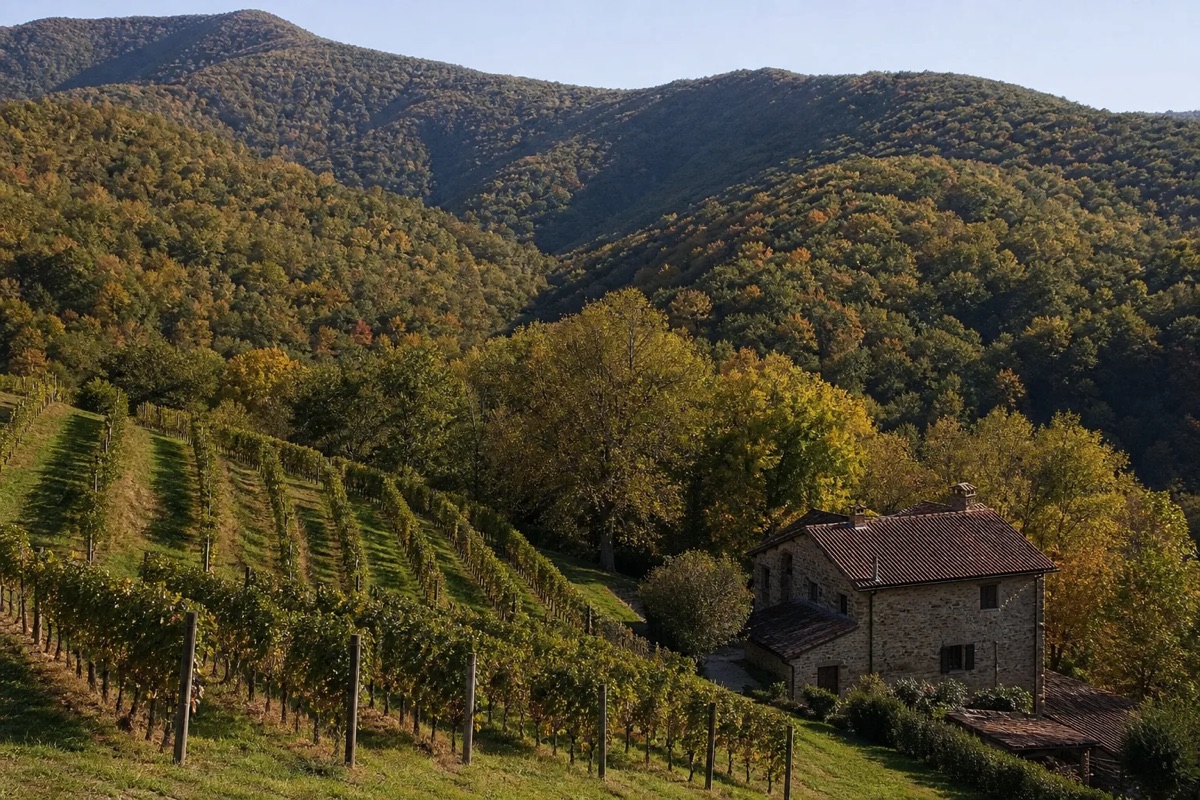
In Georgia, Racha is regarded as an almost mythical region, famed for its nature, cuisine, music and headstrong inhabitants. It is a high-lying area surrounded on all sides by mountains, with peaks of up to 4,300 metres. From lower-lying Imereti you reach the region via a winding mountain road over a pass of more than 1,200 metres, which leaves it very isolated, especially in winter. Much of its almost 2,900 square kilometres is forested, and around 1,600 hectares are planted with vines. The main towns are Ambrolauri, the centre of the region, and Oni further east.
Centuries ago Racha was best known for Khimshuri, a dry red wine made from local grapes. Driven by huge demand from Russia, where people love sweet wines, the region later became famous for something quite different: the semi-sweet red Khvanchkara, one of Georgia's most famous wines.
Khvanchkara is a protected designation of origin, in other words an appellation. It covers some 360 hectares of vineyards on both slopes of the Rioni valley. On the south side the vineyards lie at around 450 metres, on the north side at 750 to 800 metres. The north bank is considered the better terroir: the grapes get more sun there and are sheltered by the high peaks of the Caucasus, so they build up more sugar.
Khvanchkara became famous in the nineteenth century thanks to Dimitri Kipiani, a Georgian nobleman who bought up the best vineyards in Racha. He successfully marketed a traditional semi-sweet red wine that became known as "Kipiani's wine". It was based mainly on Aleksandrouli, a grape that can reach very high sugar levels, sometimes supplemented with juice from the Mujuretuli grape.
The grapes were harvested late. As it quickly turned colder at the start of winter, fermentation often stopped of its own accord, leaving some of the sugar in the wine. How sweet the wine turned out therefore varied from year to year.
In 1932 the Georgian state wine company Samtrest standardised production. From then on, fermentation was stopped artificially by chilling the must, giving the wine 30 to 50 grams of residual sugar per litre. Khvanchkara became one of the most sought-after Georgian wines, and as a result it was also often counterfeited. To combat fraud, the government has since introduced a strict system for checking the origin of the grapes.
The soils in Racha are very varied, with calcareous clay, sand, flint and in places red terra rossa on limestone. Summers are warm and dry, but winter frost and late spring frost are a risk for the grapes. Climate change also means rain falls more often during the late harvest. Racha also lies in an earthquake-prone area, and landslides have already hit several vineyards.
Traditionally the grapes were crushed by foot. The wine fermented and matured in churi, as qvevri are called here, which were sealed with clay and left outside in the cold. Today more and more winemakers want to prove that Racha can also produce fine dry wines, often working with forgotten indigenous varieties such as Rachuli Tetri. That is not easy: anyone relying solely on wild yeasts has little control over fermentation once the cold sets in, so the style can vary from year to year.
West of Racha lies Lechkhumi, an even more remote area of deep, narrow river valleys. Winegrowing here is limited to small plots in a handful of villages, often on very steep slopes. The climate is more variable than in Racha: closer to the Black Sea it is humid, while higher up in the mountains snow sometimes lies all year round. Most vineyards are in sheltered valleys with a favourable south-facing aspect.
In the past the vines were trained up trees; today they are mostly grown on wires. At the end of the nineteenth century dozens of grape varieties were still grown here. The main red grapes were Aleksandrouli and Usakhelouri, which can still be found in several villages, alongside Orbeluri Ojaleshi.
Lechkhumi has one protected designation of origin: Tvishi. The area covers about 150 hectares around the villages of Tvishi and Alpana. Tvishi is a semi-sweet white wine made from the Tsolikouri grape. It is a Soviet invention: before 1900 the grape was hardly grown in the region. After the success of the semi-sweet red Khvanchkara, the Soviets wanted a white counterpart to go with it.
The vineyards lie on limestone slopes above the Rioni river, mostly on heavy clay loam. Most of the grapes are sold to large wineries in other regions, which make a Tvishi under their own name from them, usually with 10 to 11.5 per cent alcohol and 30 to 50 grams of residual sugar per litre. A few small growers now also make dry white wine from Tsolikouri.



 Orange wine (31)
  Fresh (98)
  Light (37)
  Rosé (16)
  Aromatic (20)
  Medium (96)
  Sparkling (28)
  Ripe (70)
  Full-bodied (99)