


Germany has 13 official wine regions (Anbaugebiete), each with its own climate, soil and choice of grapes. Riesling is the best-known white grape, with the Mosel and the Rheingau as the most famous terroirs; for red wine, Spätburgunder (Pinot Noir) is the favourite, especially in Baden and the Ahr.
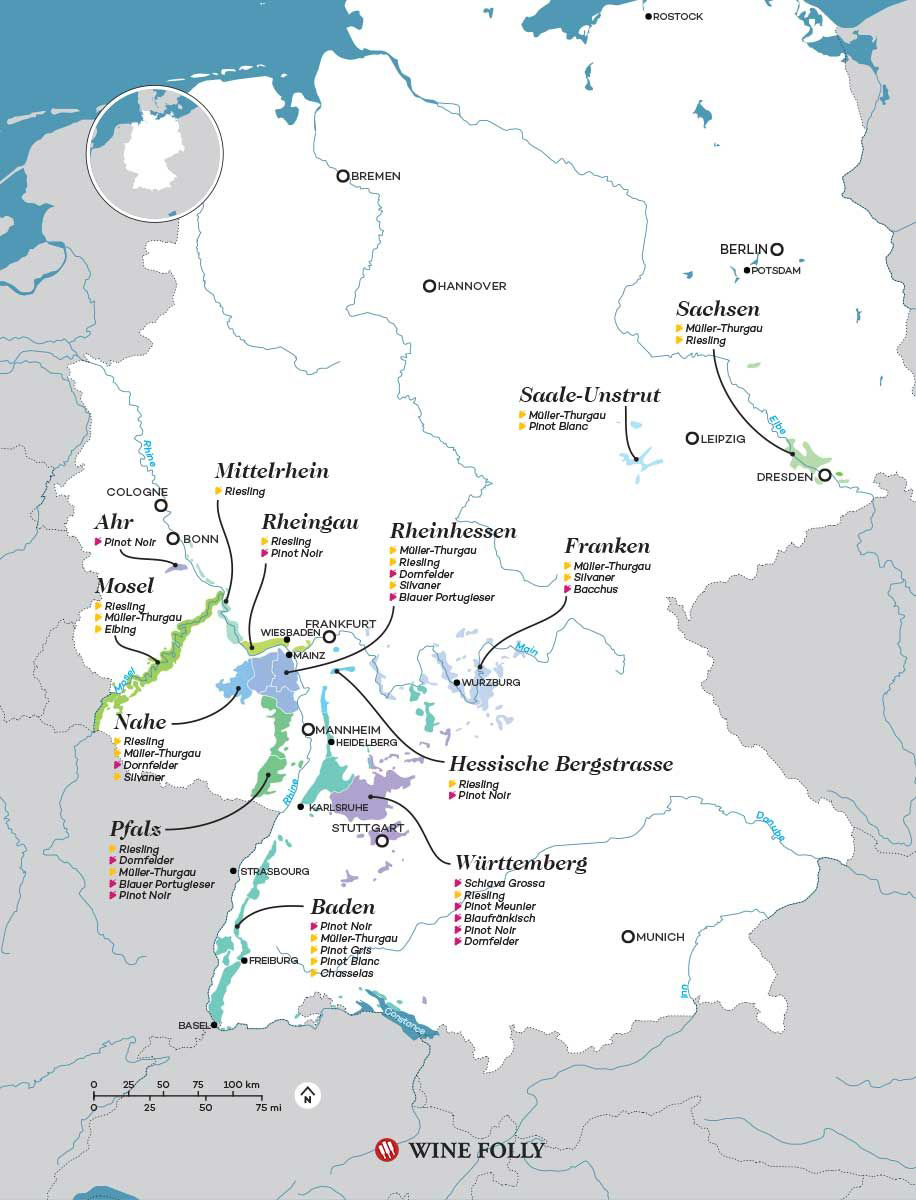
Below we describe the main German wine regions in alphabetical order. In the text you will find links to pages with more information about the various wine regions.
The Ahr is certainly not the largest or best-known of the German wine regions, but it is small and charming. This little region just below Cologne and Düsseldorf is well worth a visit for the wine lover – especially for fans of Pinot Noir, or Spätburgunder as the grape is known here. Excellent wines are made from it.
Baden lies in the far southwest of Germany, on the border with France and Switzerland. At 400 kilometres from north to south, it is one of the largest wine regions in the country. There are many different grape varieties and varying soil compositions, giving the wines of Baden an enormous diversity of character and style.
The Franken wine region lies in the middle of Germany and has short, warm summers and a wet, cold autumn. That makes it hard to produce great wines here – Riesling struggles, and it is mainly Silvaner that yields fine wines in Franken.
The southern German Hessische Bergstrasse is the country's smallest wine-growing region, with an ideal climate for viticulture. The winemakers have mainly planted Riesling; twenty percent of the wines are red, mostly made from Spätburgunder. You will not easily find them outside Germany, as the locals drink almost their entire harvest themselves.
Mittelrhein is a small German wine region, right on the Rhine and quite far north, near Bonn – one of the smallest wine regions in the country. The vines on the steep slopes along the river benefit from the warmth that lingers in the narrow valleys. Mostly Riesling is grown, with plenty of minerality and character thanks to the slate and quartz in the soil.
The Mosel is one of the best-known and most renowned wine regions of Germany: the home of Riesling, which produces unique, very fine white wines here. That is thanks to vineyards of shale and limestone on the steep slopes along the river Mosel, and to the long, warm autumn. The wines are lively and delicate, crisp with flashes of complex minerality – a byword for the connoisseur.
The Nahe is a small German wine region with vineyards along the river of the same name. It is above all the highly varied soil composition that makes the wines of the Nahe interesting. It produces fine Rieslings, but Müller-thurgau and Silvaner also do well here; red wine is mainly made from Dornfelder and Spätburgunder.
The Pfalz is one of the largest wine regions in Germany: a long strip in the middle of the country, running from Bockenheim to the French Alsace. It is known mainly for beautiful white wines from Riesling and, for German standards, plenty of red wines from Dornfelder and Spätburgunder. The winemakers of the Pfalz are innovative and love to experiment – a truly contemporary wine region.
The Rheingau is probably one of the finest wine regions in Germany. The vineyards were already planted in the twelfth century by Cistercian and Benedictine monks, and it was the first wine region in the country with an official vineyard classification. What makes it so famous? The gorgeous white wines from Riesling and the equally fine red wines from Spätburgunder.
Rheinhessen is the largest wine region in Germany. It lies in the west of the country and produces plenty of bulk wine alongside some splendid quality wines. Most of it is white – Silvaner, for example, does particularly well here – but Riesling and Spätburgunder are not lacking either.
Saale-Unstrut is the northernmost wine region of Germany, located in the east of the country. The wines are not very well known outside the region, but that is not down to quality – which has improved considerably since the fall of the Wall. Three-quarters of the wines are white and fresh in character, with Müller-thurgau leading the way.
Sachsen is the easternmost wine region of Germany and accounts for no more than 1% of German wine production. You will not easily come across wines from there; if you do, it might well be one made from the rare Goldriesling or the Elbling grape.
Southern German Württemberg is one of the few German wine regions where mostly red wine is made. It is warmer there than elsewhere, allowing dark-skinned grapes such as Trollinger and Lemberger to ripen fully. Wines from Württemberg are rarely found here – a shame, as some lovely curiosities come out of the region, such as the pale-red Schillerwein.



 Orange wine (31)
 Fresh (95)
 Light (35)
 Rosé (17)
 Aromatic (21)
 Medium (99)
 Sparkling (32)
 Ripe (72)
 Full-bodied (95)