


France has more recognised wine regions than any other country, from the world-famous Bordeaux and Burgundy to small, curious regions such as the Jura and Savoie. A complete universe of grapes, terroir and centuries-old traditions.
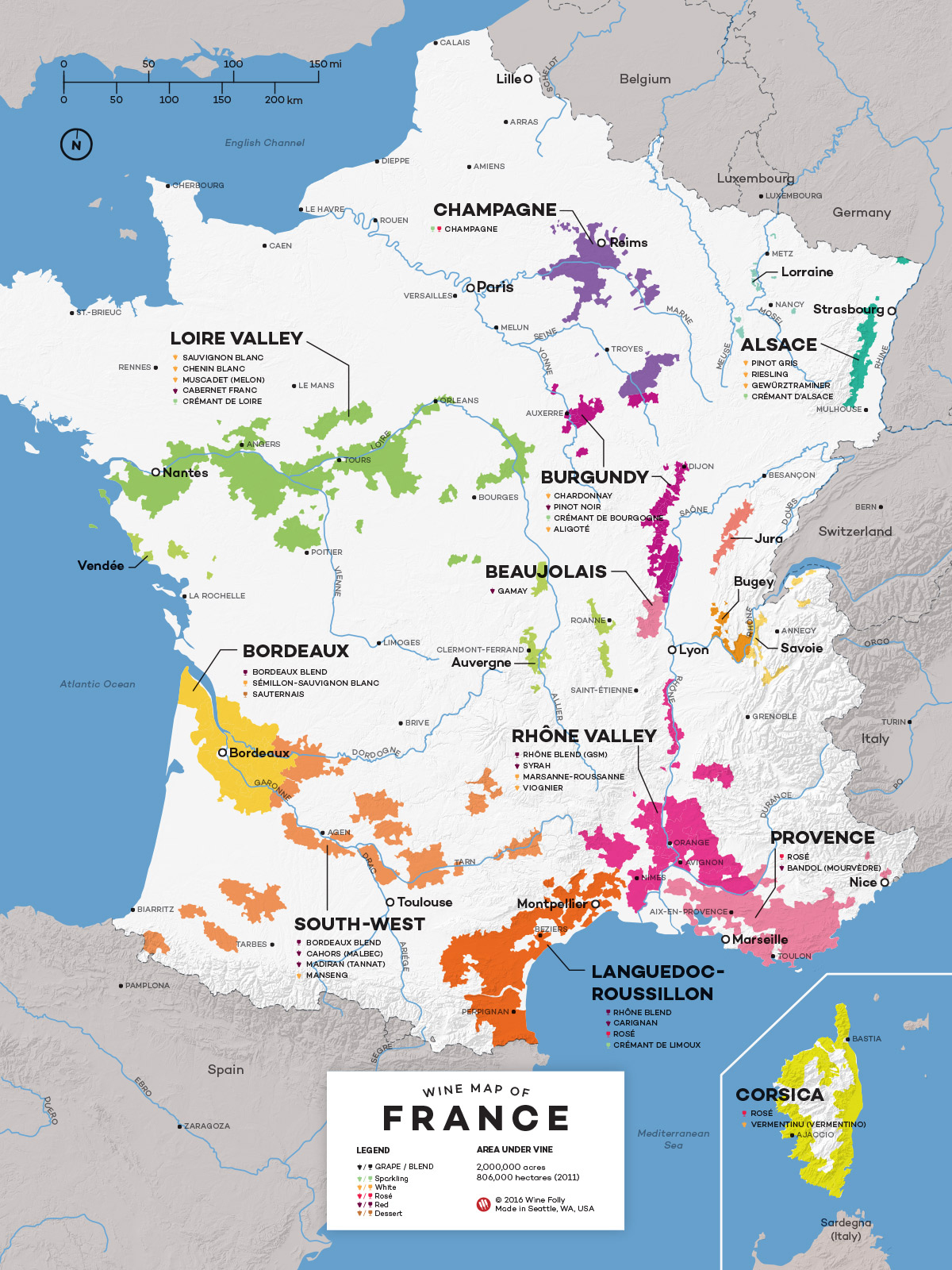
Below we describe the main French wine regions in alphabetical order. In the text you will find links to pages with more information about the various wine regions.
The French Beaujolais is best known for Beaujolais Primeur (or Nouveau), available from wine merchants worldwide on the third Thursday of November: extremely young red wine with a light, fresh taste. Less well known are the white wines from Beaujolais. Much better are the red wines that are drunk young, but not as young as the Primeur.
The Bordeaux region – or properly the Bordelais – is more than a French wine region: it is a worldwide symbol of 'good wine' and a role model for winemakers all over the world. Typical Bordeaux grapes such as Cabernet Sauvignon and Merlot have become brand names. Grands Crus and Premiers Crus from the Bordelais are sought after around the world.
The Graves wine area is the oldest in the Bordelais. Not only dry red and white wines are made here, but also noble-sweet ones: Sauternes is the most famous appellation from Graves, with intensely sweet wines that have ranked among the world's most exclusive wines for centuries.
The Médoc lies on the left bank of the Gironde, north of the city of Bordeaux: a strip about 80 kilometres long and no more than 10 kilometres wide. Monumental châteaux recall the wealth of centuries-old wine families. Médoc wines are red and dominated by Cabernet Sauvignon; in the lean soils of the gravelly banks of the Gironde, the roots must dig metres deep to gather nutrients, which makes the juice incomparably rich and complex.
The Pomerol wine area lies northwest of Saint-Emilion, in the Bordelais. The town of the same name has little character, but the wines certainly do: nowhere else but Pomerol does Merlot produce such refined truffle aromas.
For many wine lovers, the lovely town of Saint-Emilion is a place of pilgrimage. The vineyards lie on and around the hill, and differ enormously from one another – especially in soil composition and orientation to the sun. But in all the vineyards of Saint-Emilion, Merlot is the most important resident.
The Burgundy region is one of the most appealing wine areas in the world. Red wine from Burgundy is made from the delicate Pinot Noir, white mostly from Chardonnay. The Côte d'Or is the beating heart of Burgundy: here red and white wines are made that rank among the absolute world elite.
The vineyards of Chablis lie on rock that once crumbled from the mountains of the Jura: a mixture of clay, limestone and fossilised shells known as Kimmeridgian. This Kimmeridgian soil gives the Chardonnay of Chablis its mineral character and its flinty nose. Every spring, the winemakers of Chablis fear frost, which can destroy the newly budded vines and therefore the entire harvest – to prevent such a disaster, some place small stoves in the vineyards.
In the Côte de Beaune region in Burgundy, exclusive Chardonnays are made: ripe, rich white wine with a full flavour of tropical fruit, vanilla and toast. The Côte de Beaune comprises 18 communes allowed to put their own name on the label. The most important are Pommard (red wine from Pinot Noir), Volnay (also red), Meursault (white wine from Chardonnay), Puligny-Montrachet (also white) and Chassagne-Montrachet (mainly white).
The Côte de Nuits is a strip of vineyards about fifty kilometres long and a few kilometres wide, planted almost entirely with Pinot Noir. The vineyards owe their prestige to the special combination of soil, climate and the high standards of dedicated winemakers. The soil is a patchwork of different soil types, to which Pinot Noir is extremely sensitive: two wines from neighbouring vineyards in the Côte de Nuits can therefore taste very different.
Champagne is probably the best-known and most famous wine in the world. It does not matter where you are: whenever there is something important to celebrate, a bottle of Champagne is always opened. There are three reasons for this: only three grape varieties may be used, the production process is prescribed in detail, and there has been brilliant marketing for centuries.
The island of Corsica is a true wine island: more than half its area consists of vineyards. They stand in the fierce sun, but receive welcome cooling from the Mediterranean, giving the wines of Corsica a leaner, fresher character than you might expect from such a southern region. They are exported on a very modest scale.
Drive through the charming Renaissance villages of Alsace, with their romantic farmhouses, and you often feel as though you're in Germany – not so strange, since this region belonged to Germany for many years. The fresh wines made in this famous French region also sometimes bring good German wines to mind.
The Jura is certainly not France's best-known wine region, but it is a very interesting one. The Jura produces some of the most curious wines in the country: not commercial products for the masses, but unique wines with a style all of their own.
In the sprawling Languedoc, right on the Mediterranean, large quantities of dubious table wine were made at the end of the twentieth century. That has changed enormously in recent years: the Languedoc is now one of France's most innovative wine regions, sometimes called France's own 'New World'. Quality has improved spectacularly within just a few years.
The Loire valley is one of the largest and most extensive wine regions in Europe, running from the coast of Brittany to the Massif Central deep in the heart of France. Although intriguing sweet wines and fine, elegant red wines are made there, the Loire is above all synonymous with fresh white wines.
The Anjou-Saumur region lies east of Nantes in the Loire valley. Although Anjou and Saumur are usually mentioned in the same breath, there are clear differences: in Anjou, plenty of rosé and excellent noble-sweet wine is made, while in Saumur dry white wines dominate, often sparkling.
The name Nivernais or Centre, as this wine region in the Loire valley is also known, probably means little to most wine lovers. But that is not true of the five appellations that make it up: Sancerre, Quincy, Pouilly-sur-Loire, Reuilly and Menetou-Salon – by no means the least of the Loire.
The Pays Nantais region is the westernmost part of the Loire, right on the Atlantic coast. The vineyards lie south of the city of Nantes, on the left bank of the river Loire. White wine is made here from the Muscadet grape: pale yellow, musky and highly refreshing, ideal with shellfish.
The old French wine region of Touraine lies roughly in the middle of the Loire valley, near the town of Tours. Good red wines are made from Cabernet Franc, fine dry whites from Sauvignon Blanc, and dry, sparkling and gorgeous sweet white wines from Chenin Blanc.
The beautiful, sunny Provence is not only an ideal holiday destination, it also makes wine. Two-thirds is rosé; a small share consists of high-quality, mainly red wines. Unfortunately, the French drink the best wines themselves – only the rosé ends up on the shelves of the Dutch wine merchant.
As early as 600 BC, Greek colonists planted the first vines in the Rhône valley. Yet for centuries the Rhône stood in the shadow of Burgundy and Bordeaux. Today, Rhône wines are increasingly appreciated: some of the most popular grape varieties in the world originate from the Rhône valley, with Syrah (known as Shiraz outside France) and Viognier the best known.
The French Ardèche is an emerging wine region. It lies within the boundaries of the Rhône region and benefits from a Mediterranean climate with relatively cool nights, giving the wine ripeness with fine acidity. Red wines from the Ardèche are often made from Syrah, Grenache and Mourvèdre, whites from Viognier, Marsanne or Roussanne.
Châteauneuf-du-Pape is an appellation from the Rhône valley offering high-quality red and white blends. A Châteauneuf-du-Pape can be a real powerhouse, capable of developing for years. Because of its popularity, there are always less skilled winemakers wanting to cash in on its success – a Châteauneuf-du-Pape under fifteen euros should be treated with serious suspicion.
The Condrieu region lies in the northern part of the Rhône, which consists of a number of crus strung like a ribbon along the river Rhône. These are small vineyards on very steep slopes. The tiny Condrieu owes its fame to the Viognier grape: it is still regarded as the finest wine area for this grape, and winemakers simply cannot keep up with the enormous demand.
The winemakers of Cornas produce robust, sturdy red wines. Wines that need to be laid down for several years, but which, after a long wait, prove to be wonderful companions to game.
Wine from the Côte Rôtie is deep red and robust, with a full, rich aroma of raspberry, violets, sometimes a hint of pepper and often the necessary tannin. It is made from the Syrah grape. If you buy a Côte Rôtie, make sure it is not too young – it ages very well, and most are only at their best after about five years.
This region, right next to the more famous Hermitage, uses the same grapes: Syrah, Roussanne and Marsanne. Not only is it much larger, the wines made there also taste different: red is somewhat softer and fruitier, white is smooth and dry.
The commune of Gigondas lies in the southern part of the Rhône valley. Mainly powerful, sometimes fairly alcoholic red wines are made here, which generally age well. The grapes permitted in Gigondas are the same as those used further along in Châteauneuf-du-Pape.
The Hermitage region in the Rhône valley produces full, robust red wine made from Syrah, with a penetrating scent of violets and herbs and a rich, full flavour. The white wines from Hermitage are smooth and dry and are made from Marsanne and Roussanne grapes.
The Saint-Péray appellation in the northern Rhône is tiny and best known for the sparkling wines made there, although the still white wines are also worth seeking out. Marsanne is the most important grape of Saint-Péray; Roussanne is planted there relatively widely.
The hot vineyards of Roussillon lie in the southwest of France, at the foot of the Pyrenees and on the Mediterranean coast. Inland, sun-soaked dry red wines are made; the hottest vineyards right on the coast are reserved for the famous sweet red wines of Banyuls, Maury and Rivesaltes.
The wines of Savoie are not very well known, but they are interesting. In the French Alps, against the border with Switzerland, native grape varieties such as Roussette, Jacquère and Mondeuse grow that you will not find elsewhere. This gives the little-known Savoie a character all of its own.
The French Sud-Ouest is an umbrella term for several wine areas between Bordeaux and the Pyrenees. As adventurous enthusiasts, we find Madiran, Cahors and above all Gaillac interesting. In these ancient wine regions, forgotten grape varieties grow such as Loin de l'oeil, Tannat, Mauzac, Petit Manseng, Gros Manseng, Lauzet and Duras.
The Bergerac region is the best-known wine area in the Sud-Ouest. It borders the Bordelais and is perhaps better known to holidaymakers as the Dordogne. Mainly grapes also found in Bordeaux are grown here; the Dutch were already fetching their sweet wines from Bergerac as early as the fifteenth century.
Cahors in the French Sud-Ouest was once one of the most important wine regions in the world: in its 'golden' 18th century, barrels of deep red wine travelled all over the world. In the 19th century, after phylloxera devastated Europe's vineyards, Cahors fell into obscurity. Today good wine is being made there again, still from Malbec, and still deep red.
The Fronton wine area is small, barely 2,000 hectares, close to Toulouse in southern France. The winemakers here press wine from the Négrette grape, which gives soft, fruity red wines, and produce powerful red blends from the typical Bordeaux grapes.
The ancient wine region of Gaillac lies right in the south of France. For centuries it was one of the most important exporters of French wine, until it lost the competitive battle with the merchants of Bordeaux in the nineteenth century. In recent years, Gaillac and its forgotten, old grape varieties have been rediscovered by adventurous wine drinkers.
The Gascogne region is an old French wine region that fell into obscurity for years, but has enjoyed growing popularity in recent years. These are distinctive dry and sweet wines from forgotten grape varieties such as Tannat, Petit Manseng, Gros Manseng, Lauzet, Camaralet de Lasseube and Petit Courbu.
In recent years, Madiran has been rediscovered by wine lovers. The winemakers have Tannat growing in their vineyards, a robust grape they 'tame' with clever vinification techniques or by blending with other grapes. The results are striking: not everyone loves its sometimes rather firm tannin, but Madiran has become a new favourite of the creative sommelier.



 Orange wine (31)
 Fresh (95)
 Light (35)
 Rosé (17)
 Aromatic (21)
 Medium (99)
 Sparkling (32)
 Ripe (72)
 Full-bodied (95)