


Kakheti in eastern Georgia is by far the country's most important wine region. More than two thirds of all Georgian wine comes from here. The area is best known for the red Saperavi grape and the white Rkatsiteli, and for the centuries-old tradition of making wine in qvevri, large clay vessels buried in the ground. Since 2013 this method has been on UNESCO's list of intangible cultural heritage.
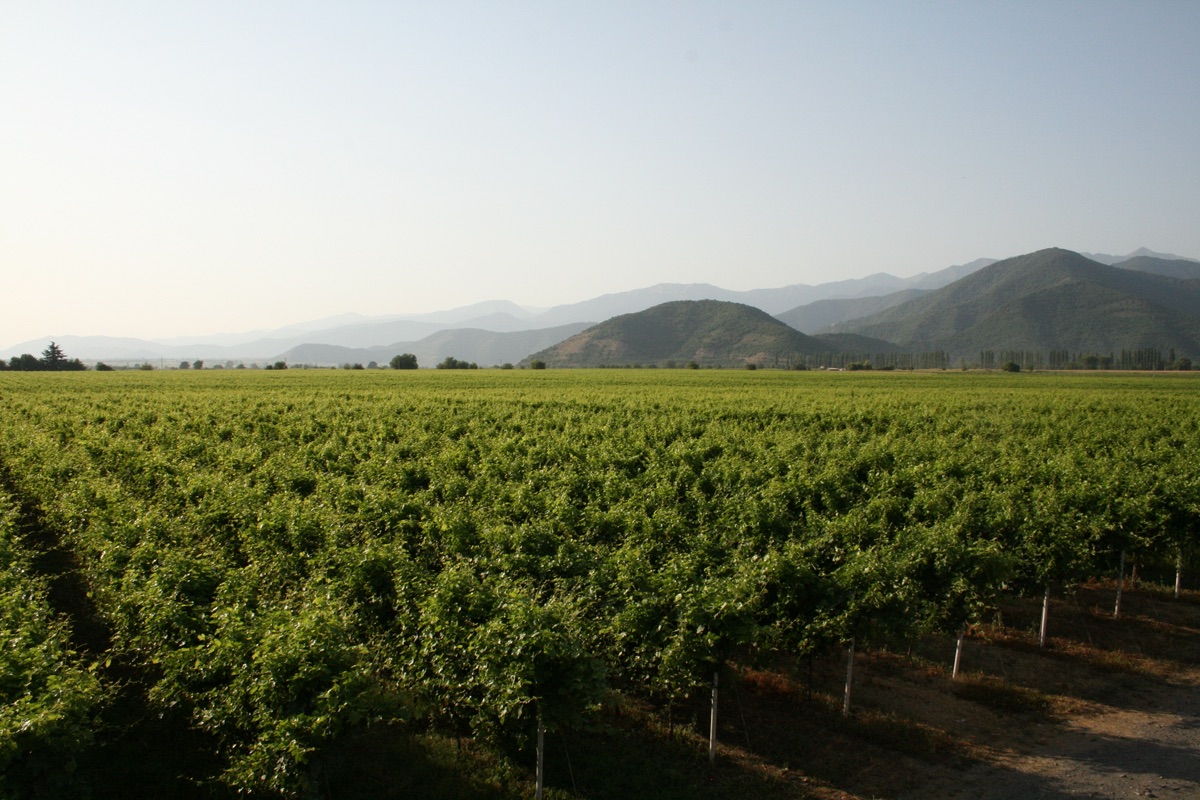
Kakheti has more appellations than any other region in Georgia, and its landscape is enormously varied: from cool slopes at the foot of the Caucasus to hot, dry plains on the border with Azerbaijan.
The heart of Kakheti is the valley of the Alazani river, which flows from north-west to south-east through the region. To the north rises the Greater Caucasus, which holds back cold air from the north. To the south lies the lower Tsiv-Gombori range.
Winegrowing is spread over both banks of the Alazani. The left bank lies at the foot of the Caucasus and is somewhat wetter. The right bank lies on the slopes of the Tsiv-Gombori range and is drier. Further south-east, around the towns of Sighnaghi and Dedoplistskaro, it is warmer and drier.
The soils are very diverse: humus-rich limestone on the slopes, brown forest soil, black earth and stony river deposits, which give way to wetter, silty soil towards the river. In general the best vineyards are on the slopes rather than on the flat, wet valley floor. Climate change is being felt here too. Glaciers in the Caucasus are melting earlier, less snow falls, and since 2012 drought has become an increasing problem. Many growers work without irrigation and plant higher up the slopes for more freshness in their wines.
For centuries Kakheti was an independent kingdom. In the sixteenth and seventeenth centuries its capital was Gremi, a flourishing trading town on the Silk Road. In 1615 the town was destroyed by the Persian armies of Shah Abbas I; only the citadel complex on the hill still stands. Telavi later became the capital, where the palace of King Erekle II can still be visited.
In the nineteenth century the Chavchavadze family played a key role in modernising Kakhetian winegrowing. On their estate in Tsinandali, wines were made in the European style, such as the white Tsinandali and later the first Cabernet Sauvignon in the Teliani valley.
In Soviet times Kakheti became the largest supplier of wine to the Soviet Union. The state wine company Samtrest marketed wines from well-known appellations such as Mukuzani, Tsinandali, Gurjaani and Kindzmarauli. These appellations are still the best known in the country, but at the time production was mainly geared to volume.
Today the focus is once again on the quality of the wines from these designations of origin. In recent decades, alongside large wineries, hundreds of small family businesses have sprung up that bottle their own wine. Many of them make their wine in qvevri, large earthenware vessels buried in the ground.
The most important red grape in Kakheti is Saperavi, which produces dark, powerful wines, from dry and firm to semi-sweet. Among the white grapes Rkatsiteli dominates, supplemented by Mtsvane, Kisi and Khikhvi. There are two main styles. In the European style the white grapes are fermented without their skins. In the traditional Kakhetian style they ferment and mature for months with their skins, and sometimes stems, in qvevri, producing amber-coloured wines with firm tannins. Which style is permitted varies by designation of origin.
The left bank is home to Kvareli, Kindzmarauli, Napareuli and Artana, among others, where the wines are somewhat finer and less powerful than on the right bank. A century ago Kvareli was already regarded as the source of Kakheti's best wines. It is warmer but also wetter than the areas upstream, and Saperavi is the main grape. Nearby lies Kindzmarauli, Kakheti's most famous semi-sweet red wine. Further east lies Lagodekhi, a wet area best known for its national park, where most of the grapes go to large wineries.
The right bank is a strip some 75 kilometres long between Akhmeta and Anaga, and the centre of gravity of Kakhetian winegrowing. In the north-west, around Akhmeta, the vineyards lie at 700 to 740 metres. This area is known for white grapes such as Mtsvane, Kisi and Khikhvi. Towards the south-east the land gradually descends, via Ikalto and the regional capital Telavi, to Gurjaani at around 400 metres.
This is also where some of the most famous designations of origin are found. Tsinandali is known for its dry white wine in the European style, and within that area lies Teliani, known for Cabernet Sauvignon. Mukuzani, in the warmer Gurjaani district, produces powerful, deeply coloured dry red wine from Saperavi. Akhasheni is the southern counterpart of Kindzmarauli, with semi-sweet red wine. Gurjaani, with more than 1,100 hectares one of the larger designations of origin, produces broad, ripe wines with soft acidity. Kardenakhi makes a fortified sweet white wine, mainly from Khikhvi.
Further south-east, around Sighnaghi and Dedoplistskaro, it becomes warmer and drier. This area used to be seen as less important, but it has some interesting places, such as Anaga and the Tibaani designation of origin, where a qvevri wine is made from Rkatsiteli. Around Dedoplistskaro so little rain falls that irrigation is necessary, and the soil consists largely of fertile black earth. Most of the grapes are sold to large producers, but since 2015 more and more families here have been bottling their own wine.
Kakheti combines tradition and renewal like no other Georgian region. Classic Soviet-era brand wines exist alongside artisanal qvevri wines from small family businesses, and large wineries are investing in historic estates. Anyone wanting to get to know Georgian wine almost always starts in Kakheti, and discovers a wine region far more varied than its reputation suggests. We currently have thirty-seven wines from Kakheti in our range. You can view all our wines from Kakheti here.



 Orange wine (27)
 Fresh (89)
 Light (36)
 Rosé (14)
 Aromatic (21)
 Medium (96)
 Sparkling (27)
 Ripe (70)
 Full-bodied (100)


